 DecodedCars
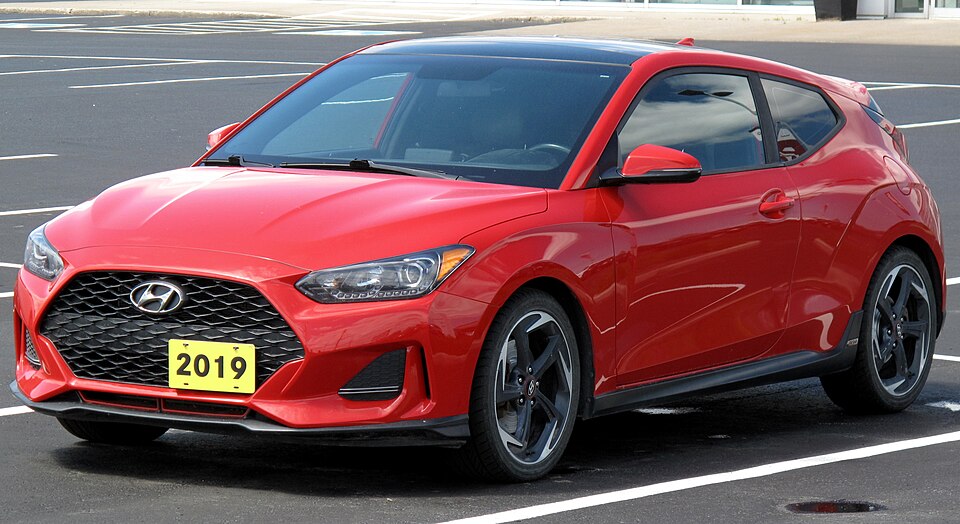
2017 Hyundai Veloster
Trims, performance, features, fuel economy, safety and known problems — with the pros and cons against similar 2017 models.
- Class
- Compact Cars
- Body styles
- 3dr Hatchback, Turbo 3dr Hatchback
- Engines
- 1.6L 4-cyl, 1.6L 4-cyl turbo
- Drivetrain
- Front-Wheel Drive
- Fuel
- Regular Gasoline
- MPG (best)
- 31 combined · 28 city / 35 hwy
- Length
- 166.1–167.3 in
- Curb weight
- 2,584–2,740 lb
- NHTSA rating
- Not rated
- Recalls
- 0 campaigns
Pros & cons
What's good
- Excellent fuel economyUp to 31 MPG combined — 15% better than the average 2017 compact car (26.9 MPG).
- No recalls so far
Watch out for
No weak spots against similar models in the data.
Calculated from EPA, NHTSA and vPIC data against 17 similar 2017 models — not a review. How we calculate this →
Overview
The 2017 Hyundai Veloster is a compact car offered with 2 engines (1.6L 4-cyl and 1.6L 4-cyl turbo) and front-wheel drive.
It measures about 166 inches long and 71 inches wide on a 104-inch wheelbase, with a curb weight of roughly 2,740 lb (3dr Hatchback).
EPA rates its most efficient version at 31 MPG combined (28 city / 35 highway), 15% better than the 2017 compact car average of 26.9 MPG, for an estimated $2,150 a year in fuel.
NHTSA has not published a 5-Star overall rating for this model year.
It has 0 recall campaigns on file and owners have filed 50 complaints with NHTSA since 2015, most often about the engine.
What changed for 2017
No changes to engines, powertrains, drivetrains, size, EPA ratings or NHTSA crash rating compared with the 2016 Veloster — a carry-over year in the data.
Compared with 2016; trim, feature and price changes aren't covered. See the 2016 Veloster →
Dimensions & weight
| Body | Length | Width | Height | Wheelbase | Track F / R | Curb weight | Weight F/R |
|---|---|---|---|---|---|---|---|
| 3dr Hatchback | 166.1 in | 70.5 in | 55.1 in | 104.3 in | 61.4 / 61.4 in | 2,740 lb | 60/40 |
| Turbo 3dr Hatchback | 167.3 in | 71.3 in | 55.1 in | 104.3 in | 61.4 / 61.8 in | 2,584 lb | 60/40 |
Transport Canada CVS (Open Government Licence – Canada), Canadian-market figures.
Will it fit your garage? Check with your measurements →Engines, MPG & running costs
| Version | Engine | Transmission | Drive | City / Hwy / Comb | vs. class | Fuel / yr | CO₂ g/mi |
|---|---|---|---|---|---|---|---|
| Veloster | 1.6L 4-cyl | Automatic (AM6) | Front-Wheel Drive | 28 / 35 / 31 | +15% | $2,150 | 288 |
| Veloster | 1.6L 4-cyl | Manual 6-spd | Front-Wheel Drive | 27 / 34 / 30 | +12% | $2,250 | 304 |
| Veloster | 1.6L 4-cyl turbo | Automatic (AM7) | Front-Wheel Drive | 26 / 32 / 29 | +8% | $2,300 | 310 |
| Veloster | 1.6L 4-cyl turbo | Manual 6-spd | Front-Wheel Drive | 25 / 33 / 28 | +4% | $2,400 | 321 |
EPA estimates; "vs. class" is combined MPG against the 2017 EPA class average. How we calculate this →
Safety ratings & technology
NHTSA has not published 5-Star ratings for the 2017 Hyundai Veloster.
Similar 2017 compact cars
| Model | Best MPG / range | NHTSA overall | Recalls |
|---|---|---|---|
| 2017 Hyundai Veloster (this car) | 31 MPG | Not rated | 0 |
| 2017 Mazda 3 | 32 MPG | Not rated | 0 |
| 2017 Volkswagen Golf/GTI | 29 MPG | ★★★★★ | 5 |
| 2017 Ford Focus | 34 MPG | ★★★★★ | 10 |
| 2017 Ford Fiesta | 35 MPG | Not rated | 0 |
| 2017 Nissan Leaf | 107 mi | Not rated | 2 |
| 2017 Mazda 2 | 35 MPG | Not rated | 0 |
Recalls (0)
No vehicle recalls on file with NHTSA for the 2017 Hyundai Veloster.
Check your VIN for open recalls at NHTSA ↗Not every 2017 Hyundai Veloster is affected — only a VIN check confirms your car.
Owner-reported problems
Unverified owner reports; best-sellers collect more.
Used 2017 Hyundai Veloster buyer's checklist
- Run the VIN at nhtsa.gov/recalls. No recalls on file, but check anyway.
- Engine — 26 owner reports. Cold-start the engine, listen for knocking, and watch for warning lights or hesitation on acceleration.
- Power Train — 7 owner reports. Test-drive through all gears, including reverse; note slipping, harsh or delayed shifts.
- Air Bags — 6 owner reports. Confirm the airbag warning light turns off after start-up and any airbag recall was completed.
- Mileage to watch. Owners typically reported problems around 48,000 miles; ask what was repaired near that point.
- Before you pay: service records, a history report and an independent inspection.
Generated by DecodedCars from NHTSA recalls and owner complaints for the 2017 Hyundai Veloster. Not a substitute for a professional inspection.
Other Veloster years
Compare all years →| Year | MPG (best) | Length | Overall | Recalls | Complaints |
|---|---|---|---|---|---|
| 2022 Veloster | 25 | 166.9 in | Not rated | 2 | 37 |
| 2021 Veloster | 30 | 166.9 in | Not rated | 3 | 29 |
| 2020 Veloster | 30 | 166.9 in | Not rated | 2 | 29 |
| 2019 Veloster | 30 | 166.9 in | Not rated | 3 | 46 |
| 2016 Veloster | 31 | 166.1 in | Not rated | 1 | 224 |
| 2015 Veloster | 30 | 166.1 in | Not rated | 2 | 137 |
| 2014 Veloster | 30 | 166.1 in | Not rated | 2 | 84 |
| 2013 Veloster | 31 | 166.1 in | Not rated | 3 | 382 |
| 2012 Veloster | 31 | 166.1 in | Not rated | 6 | 202 |
Sources: EPA, NHTSA, Transport Canada, Wikimedia Commons. Not affiliated with NHTSA, the EPA or Hyundai. How we calculate this →