 DecodedCars
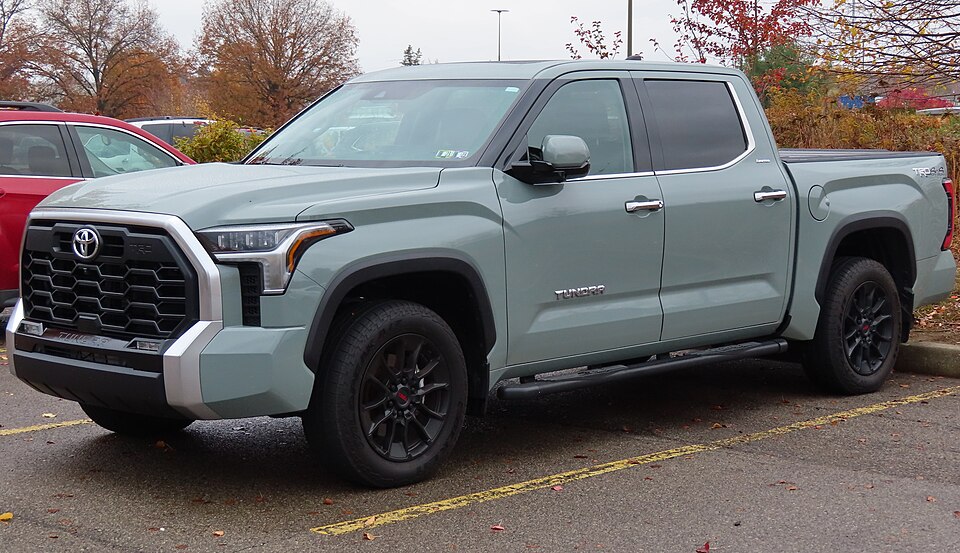
2013 Toyota Tundra
Trims, performance, features, fuel economy, safety and known problems — with the pros and cons against similar 2013 models.
- Class
- Standard Pickup Trucks 2WD
- Body styles
- Crew Max S/Box 4WD Sr5/Platinum, Double Cab L/Box 2WD Sr5 5.7l, Double Cab L/Box 4WD, Double Cab M/Box 2WD Sr5 4.6l
- Engines
- 4.0L 6-cyl, 4.6L 8-cyl, 5.7L 8-cyl
- Drivetrain
- Rear-Wheel Drive, Part-time 4-Wheel Drive
- Fuel
- Regular Gasoline, FFV
- MPG (best)
- 17 combined · 16 city / 20 hwy
- Length
- 226–244.9 in
- Curb weight
- 4,910–5,659 lb
- NHTSA rating
- Not rated
- Recalls
- 5 campaigns
Pros & cons
What's good
- AWD / 4WD available
- Few owner complaints70 complaints filed with NHTSA versus about 391 for similar models.
Watch out for
No weak spots against similar models in the data.
Calculated from EPA, NHTSA and vPIC data against 4 similar 2013 models — not a review. How we calculate this →
Overview
The 2013 Toyota Tundra is a standard pickup truck offered with 3 engines (4.0L 6-cyl, 4.6L 8-cyl and 5.7L 8-cyl) and rear-wheel drive and part-time 4-wheel drive.
It measures about 226 inches long and 80 inches wide on a 146-inch wheelbase, with a curb weight of roughly 5,624 lb (Crew Max S/Box 4WD Sr5/Platinum).
EPA rates its most efficient version at 17 MPG combined (16 city / 20 highway), 2% worse than the 2013 standard pickup truck average of 17.3 MPG, for an estimated $3,950 a year in fuel.
NHTSA has not published a 5-Star overall rating for this model year.
It has 5 recall campaigns on file and owners have filed 70 complaints with NHTSA since 2015, most often about the engine.
What changed for 2013
No changes to engines, powertrains, drivetrains, size, EPA ratings or NHTSA crash rating compared with the 2012 Tundra — a carry-over year in the data.
Compared with 2012; trim, feature and price changes aren't covered. See the 2012 Tundra →
Dimensions & weight
| Body | Length | Width | Height | Wheelbase | Track F / R | Curb weight | Weight F/R |
|---|---|---|---|---|---|---|---|
| Crew Max S/Box 4WD Sr5/Platinum | 226 in | 79.9 in | 76.4 in | 145.7 in | 67.3 / 67.7 in | 5,624 lb | 58/42 |
| Double Cab L/Box 2WD Sr5 5.7l | 244.9 in | 79.9 in | 76 in | 164.6 in | 67.3 / 67.7 in | 5,357 lb | 58/42 |
| Double Cab L/Box 4WD | 244.9 in | 79.9 in | 76.4 in | 164.6 in | 67.3 / 67.7 in | 5,659 lb | 58/42 |
| Double Cab M/Box 2WD Sr5 4.6l | 226 in | 79.9 in | 76 in | 145.7 in | 67.3 / 67.7 in | 5,084 lb | 58/42 |
| Double Cab M/Box 4WD Sr5 4.6l/Sr5 5.7/ | 226 in | 79.9 in | 76.4 in | 145.7 in | 67.3 / 67.7 in | 5,459 lb | 58/42 |
| Reg Cab L/Box 2WD | 226 in | 79.9 in | 76 in | 145.7 in | 67.7 / 67.7 in | 4,910 lb | 58/42 |
Transport Canada CVS (Open Government Licence – Canada), Canadian-market figures.
Will it fit your garage? Check with your measurements →Engines, MPG & running costs
| Version | Engine | Transmission | Drive | City / Hwy / Comb | vs. class | Fuel / yr | CO₂ g/mi |
|---|---|---|---|---|---|---|---|
| Tundra 2WD | 4.0L 6-cyl | Automatic (S5) | Rear-Wheel Drive | 16 / 20 / 17 | -2% | $3,950 | 506 |
| Tundra 2WD | 4.6L 8-cyl | Automatic (S6) | Rear-Wheel Drive | 15 / 20 / 17 | -2% | $3,950 | 528 |
| Tundra 4WD | 4.6L 8-cyl | Automatic (S6) | Part-time 4-Wheel Drive | 14 / 19 / 16 | -1% | $4,200 | 560 |
| Tundra 2WD | 5.7L 8-cyl | Automatic (S6) | Rear-Wheel Drive | 13 / 18 / 15 | -13% | $4,450 | 585 |
| Tundra 4WD | 5.7L 8-cyl | Automatic (S6) | Part-time 4-Wheel Drive | 13 / 17 / 15 | -7% | $4,450 | 605 |
| Tundra 4WD FFV FFV | 5.7L 8-cyl | Automatic (S6) | Part-time 4-Wheel Drive | 13 / 18 / 15 | -7% | $4,450 | 592 |
EPA estimates; "vs. class" is combined MPG against the 2013 EPA class average. How we calculate this →
Safety ratings & technology
NHTSA has not published 5-Star ratings for the 2013 Toyota Tundra.
Similar 2013 standard pickup trucks
| Model | Best MPG / range | NHTSA overall | Recalls |
|---|---|---|---|
| 2013 Toyota Tundra (this car) | 17 MPG | Not rated | 5 |
| 2013 Chevrolet Silverado | 21 MPG | Not rated | 7 |
| 2013 Toyota Tacoma | 23 MPG | Not rated | 6 |
| 2013 Ram 1500 | 21 MPG | Not rated | 11 |
| 2013 GMC Sierra | 21 MPG | Not rated | 7 |
Recalls (5)
Steering › Hydraulic Power Assist System · Nov 23, 2021
NHTSA campaign 21V920000 · 22,462 vehicles
- Problem
- Toyota Motor Engineering & Manufacturing (Toyota) is recalling certain 2008-2022 Sequoia and 2007-2021 Tundra vehicles. The power steering gear assembly may have been manufactured incorrectly, which can result in an oil leak.
- Risk
- An oil leak may cause a sudden loss of power steering assist, increasing the risk of a crash.
- Fix
- Dealers will inspect and replace the power steering gear assembly as necessary, free of charge. Owner notification letters were mailed on January 21, 2022. Owners may contact Toyota customer service at 1-800-331-4331. Toyota's numbers for this recall are 21TB10 and 21TA10.
Wheels › Lugs/Nuts/Bolts/Studs · May 11, 2017
NHTSA campaign 17V311000 · 1,325 vehicles
- Problem
- Southeast Toyota Distributors, LLC (SET) is recalling certain model year 2013-2017 Toyota Tundra and Sequoia vehicles accessorized with Southeast Toyota accessory 20-inch Rockstar wheels installed by Southeast Toyota or a Southeast Toyota dealer. The Rockstar wheels were installed with lugnuts that may crack and detach.
- Risk
- Lugnuts that crack and detach may cause the wheels to separate from the vehicle, increasing the risk of a crash.
- Fix
- SET will notify owners, and dealers will install new replacement lugnuts, free of charge. The recall began June 23, 2017. Owners may contact SET customer service at 1-866-405-4226. SET's number for this recall is SET17A.
Wheels › Lugs/Nuts/Bolts/Studs · Jul 16, 2014
NHTSA campaign 14V429000 · 16,249 vehicles
- Problem
- Gulf States Toyota, Inc. (GST) is recalling certain model year 2013-2014 Toyota Tundra vehicles modified by GST as part of certain vehicle packages to be equipped with a combination of non-Toyota-brand 20-inch alloy wheels and chrome plated lug nuts. The coating on the lug nuts may give, causing the lug nuts to loosen or the wheel studs to fracture.
- Risk
- If the lug nuts loosen, or the wheel studs fracture, the wheel may separate from the vehicle, increasing the risk of a crash.
- Fix
- GST will notify owners, and dealers will replace 20 lug nuts and torque them to specification, free of charge. The recall began in August 2014. Owners may contact GST customer service at 1-800-444-1074.
Equipment › Other › Labels · Apr 9, 2013
NHTSA campaign 13V123000 · 7,525 vehicles
- Problem
- Southeast Toyota is recalling certain model year 2008 and 2010-2013 Toyota Tundra, 2010-2012 Rav4, 2012 Toyota Sequoia, 2010-2011 Toyota Corolla, 2010-2011 Toyota Camry and Camry Hybrid, 2010-2013 Toyota Highlander and Highlander Hybrid, 2010-2013 Toyota FJ Cruiser, 2011 Toyota Land Cruiser, 2010-2013 Toyota Venza, 2010-2011 Toyota 4Runner, 2010-2013 Toyota Tacoma, 2011-2012 Toyota Sienna, 2012 Toyota Prius, 2013 Scion FR-S, 2011 Scion XD, 2011 Scion XB, and 2012 Scion TC vehicles. These vehicles were sold with labels that were outside the allowable one percent of accuracy of actual weight added. Thus, these vehicles fail to comply with the requirements of Federal Motor Vehicle Safety Standard (FMVSS) Number 110, "Tire Selection and Rims."
- Risk
- An inaccurate label could lead to owners overloading their vehicles and tires. An overloaded vehicle can result in a tire failure which may result in a vehicle crash, personal injury, or property damage.
- Fix
- Southeast Toyota will notify owners and provide a corrected label with instructions concerning its installation. A small group of the affected vehicles will need additonal remedies which are still being developed. The recall began on May 28, 2013. Owners may contact Southeast Toyota at 1-800-301-6859.
Seats · Jan 16, 2013
NHTSA campaign 13V014000 · 3,235 vehicles
- Problem
- Southeast Toyota Distributors, LLC (SET) is recalling certain models interspersed through model years 2009 through 2013 as follows: model year 2009-2012 Tacoma, 4Runner, Camry, Camry Hybrid, Prius, and RAV4; model year 2009-2010 Avalon, FJ Cruiser, and Highlander Hybrid; model year 2010-2013 model year Corolla, Sienna and Tundra; model year 2009-2013 Highlander and Venza; model year 2012 Prius V; and model year 2010-2012 Sequoia. During modification by SET to include accessories such as leather seat covers, seat heaters or headrest DVD systems, these vehicles may not have had the passenger seat occupant sensing system calibration tested. Without passing the calibration test, the occupant sensing system may not operate as designed.
- Risk
- If the front passenger seat occupant sensing system is out of calibration, the front passenger airbags may not deploy or they may deploy inappropriately for the passenger's size and position. This could increase the risk of personal injury during the event of a vehicle crash necessitating airbag deployment.
- Fix
- Southeast Toyota will notify owners, and dealers will test the sensitivity of the occupant detection sensors, and recalibrate them as necessary. The recall began on March 21, 2013. Owners may contact Southeast Toyota at 1-800-301-6859.
Not every 2013 Toyota Tundra is affected — only a VIN check confirms your car.
Owner-reported problems
Unverified owner reports; best-sellers collect more.
Used 2013 Toyota Tundra buyer's checklist
- Run the VIN at nhtsa.gov/recalls. 5 recalls this year — ask for proof of repairs.
- Engine — 22 owner reports. Cold-start the engine, listen for knocking, and watch for warning lights or hesitation on acceleration.
- Fuel/Propulsion System — 12 owner reports. Smell for fuel around the car and in the cabin, check that it starts easily when warm, and look at the oil dipstick for a fuel smell or rising level.
- Electrical System — 8 owner reports. Test every window, lock, light, screen and USB port; check the battery age.
- Mileage to watch. Owners typically reported problems around 64,000 miles; ask what was repaired near that point.
- Before you pay: service records, a history report and an independent inspection.
Generated by DecodedCars from NHTSA recalls and owner complaints for the 2013 Toyota Tundra. Not a substitute for a professional inspection.
Other Tundra years
Compare all years →| Year | MPG (best) | Length | Overall | Recalls | Complaints |
|---|---|---|---|---|---|
| 2026 Tundra | 22 | 245.7 in | Not rated | 2 | 37 |
| 2025 Tundra | 22 | 245.7 in | ★★★★★ | 5 | 142 |
| 2024 Tundra | 22 | 245.7 in | ★★★★★ | 10 | 353 |
| 2023 Tundra | 22 | 245.7 in | ★★★★★ | 13 | 414 |
| 2022 Tundra | 22 | 245.7 in | ★★★★★ | 13 | 434 |
| 2021 Tundra | 15 | 226 in | ★★★★★ | 2 | 24 |
| 2020 Tundra | 15 | 226 in | ★★★★★ | 4 | 47 |
| 2019 Tundra | 16 | 226 in | ★★★★★ | 9 | 74 |
| 2018 Tundra | 16 | 226 in | ★★★★★ | 8 | 100 |
| 2017 Tundra | 16 | 226 in | ★★★★★ | 5 | 78 |
| 2016 Tundra | 17 | 226 in | Not rated | 5 | 120 |
| 2015 Tundra | 17 | 226 in | Not rated | 4 | 51 |
Sources: EPA, NHTSA, Transport Canada, Wikimedia Commons. Not affiliated with NHTSA, the EPA or Toyota. How we calculate this →