 DecodedCars
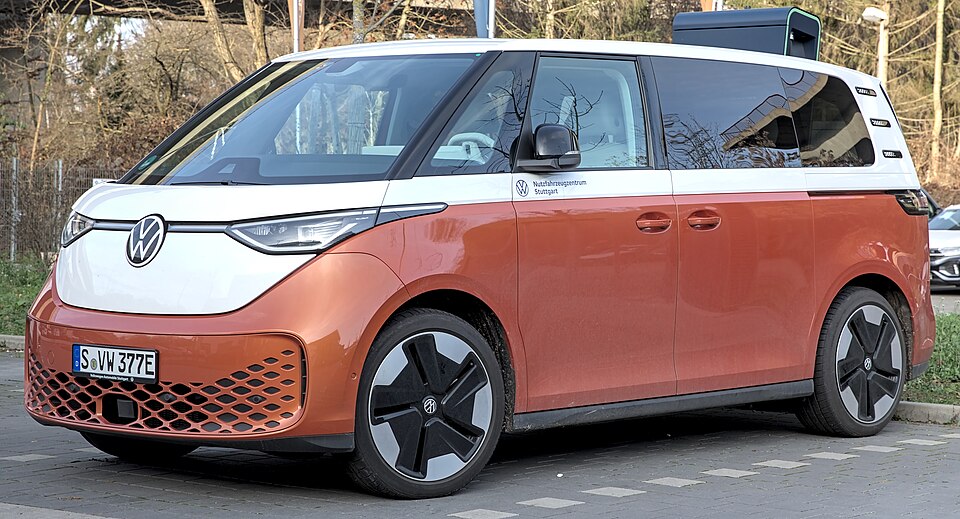
2025 Volkswagen ID. Buzz
Trims, performance, features, fuel economy, safety and known problems — with the pros and cons against similar 2025 models.
- Class
- Minivan - 2WD
- Body styles
- Id.Buzz Bev Minivan AWD, Id.Buzz Bev Minivan RWD
- Engines
- Electric motor
- Horsepower
- 282–335 hp
- Transmission
- 1-speed automatic
- Drivetrain
- Rear-Wheel Drive, All-Wheel Drive
- Seats
- 6–7
- Fuel
- EV
- EV range
- 234 mi · 9 h on 240 V
- Length
- 195.3 in
- Curb weight
- 6,109–6,261 lb
- NHTSA rating
- Not rated
- Recalls
- 2 campaigns
Pros & cons
What's good
- AWD / 4WD available
- Seats up to 73 rows of seating.
- Lots of standard safety tech5 of 5 key driver aids standard on the versions we checked.
Watch out for
No weak spots against similar models in the data.
Calculated from EPA, NHTSA and vPIC data against 5 similar 2025 models — not a review. How we calculate this →
Overview
The 2025 Volkswagen ID. Buzz is a minivan powered by electricity and rear-wheel drive and all-wheel drive.
It measures about 195 inches long and 78 inches wide on a 128-inch wheelbase, with a curb weight of roughly 6,261 lb (Id.Buzz Bev Minivan AWD).
The electric version has an EPA-rated range of up to 234 miles and takes about 9 hours to charge on a 240-volt Level 2 charger.
NHTSA has not published a 5-Star overall rating for this model year.
It has 2 recall campaigns on file and owners have filed 16 complaints with NHTSA since 2015, most often about the unknown or other.
Trims, performance & features
Trims
Safety & driver-assist features
Built in: Hannover, Lower Saxony
NHTSA vPIC, as reported by the manufacturer for 4 2025 ID. Buzz configurations; may not list every trim. How we calculate this →
Dimensions & weight
| Body | Length | Width | Height | Wheelbase | Track F / R | Curb weight | Weight F/R |
|---|---|---|---|---|---|---|---|
| Id.Buzz Bev Minivan AWD | 195.3 in | 78 in | 76.4 in | 127.6 in | 65.7 / 65.7 in | 6,261 lb | |
| Id.Buzz Bev Minivan RWD | 195.3 in | 78 in | 76.4 in | 127.6 in | 65.7 / 65.7 in | 6,109 lb |
Transport Canada CVS (Open Government Licence – Canada), Canadian-market figures.
Will it fit your garage? Check with your measurements →Engines, MPG & running costs
| Version | Engine | Transmission | Drive | City / Hwy / Comb | vs. class | Fuel / yr | CO₂ g/mi |
|---|---|---|---|---|---|---|---|
| ID. Buzz EV | 210 kW AC 3-Phase | Automatic (A1) | Rear-Wheel Drive | 234 mi · 40.7703 kWh/100mi | – | $900 | – |
| ID. Buzz 4motion EV | 80 and 210 kW AC 3-Phase | Automatic (A1) | All-Wheel Drive | 231 mi · 41.9661 kWh/100mi | – | $950 | – |
EPA estimates; "vs. class" is combined MPG against the 2025 EPA class average. How we calculate this →
Safety ratings & technology
NHTSA has not published 5-Star ratings for the 2025 Volkswagen ID. Buzz.
Similar 2025 minivans
| Model | Best MPG / range | NHTSA overall | Recalls |
|---|---|---|---|
| 2025 Volkswagen ID. Buzz (this car) | 234 mi | Not rated | 2 |
| 2025 Toyota Sienna | 36 MPG | Not rated | 6 |
| 2025 Kia Carnival | 33 MPG | Not rated | 1 |
| 2025 Honda Odyssey | 22 MPG | ★★★★★ | 2 |
| 2025 Chrysler Voyager | 22 MPG | ★★★★★ | 6 |
| 2025 Chrysler Pacifica | 30 MPG | ★★★★★ | 10 |
Recalls (2)
Seats › Mid/Rear Assembly · May 15, 2025
NHTSA campaign 25V269000 · 5,644 vehicles
- Problem
- Volkswagen Group of America, Inc. (Volkswagen) is recalling certain 2025 ID. BUZZ vehicles. The third-row rear bench is wide enough for three passengers, but is designed for two passengers and equipped with two seat belts. As such, these vehicles fail to comply with the requirements of Federal Motor Vehicle Safety Standard number 208, "Occupant Crash Protection."
- Risk
- In the event that more than two passengers sit in the rear bench seat, there would not be enough seat belts, increasing the risk of injury during a crash.
- Fix
- Dealers will install trim to adjust the width of the third-row rear seats, free of charge. Owner notification letters were mailed June 20, 2025. Owners may contact Volkswagen customer service at 1-800-893-5298. Volkswagen's number for this recall is 72LC.
Electrical System › Instrument Cluster/Panel · Apr 10, 2025
NHTSA campaign 25V233000 · 5,637 vehicles
- Problem
- Volkswagen Group of America, Inc. (Volkswagen) is recalling certain 2025 ID. Buzz vehicles. The brake system warning light on the instrument panel display may be the incorrect symbol and color. As such, these vehicles fail to comply with the requirements of Federal Motor Vehicle Safety Standard numbers 135, "Light Vehicle Brake Systems" and 101, "Control and Displays."
- Risk
- An incorrectly displayed warning light can fail to alert the driver to critical safety information, increasing the risk of a crash.
- Fix
- Dealers will update the instrument panel software, free of charge. Owner notification letters were mailed June 6, 2025. Owners may contact Volkswagen customer service at 1-800-893-5298. Volkswagen's number for this recall is 90A2.
Not every 2025 Volkswagen ID. Buzz is affected — only a VIN check confirms your car.
Owner-reported problems
Unverified owner reports; best-sellers collect more.
Used 2025 Volkswagen ID. Buzz buyer's checklist
- Run the VIN at nhtsa.gov/recalls. 2 recalls this year — ask for proof of repairs.
- Electrical System — 3 owner reports. Test every window, lock, light, screen and USB port; check the battery age.
- Structure › Body — 2 owner reports. Open and close every door, the hood and tailgate; look for rust or misaligned panels.
- Service Brakes — 2 owner reports. Brake firmly from speed; check for pulling, pulsing pedal or ABS warning light.
- Mileage to watch. Owners typically reported problems around 6,600 miles; ask what was repaired near that point.
- Battery health. Ask for a battery state-of-health report, check the remaining battery warranty, and compare the displayed range at 100% charge with the EPA's 234 miles.
- Before you pay: service records, a history report and an independent inspection.
Generated by DecodedCars from NHTSA recalls and owner complaints for the 2025 Volkswagen ID. Buzz. Not a substitute for a professional inspection.
Sources: EPA, NHTSA, Transport Canada, Wikimedia Commons. Not affiliated with NHTSA, the EPA or Volkswagen. How we calculate this →