 DecodedCars
2026 Chevrolet TrailBlazer
Trims, performance, features, fuel economy, safety and known problems — with the pros and cons against similar 2026 models.
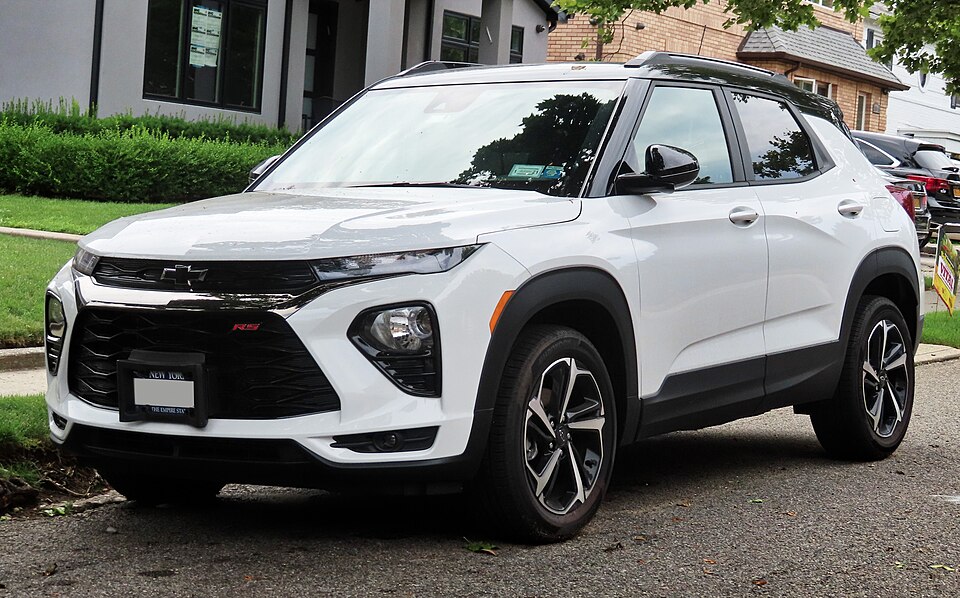
- Class
- Small Sport Utility Vehicle 2WD
- Body styles
- 4dr SUV 1.2l FWD, 4dr SUV 1.3l FWD, 4dr SUV AWD
- Engines
- 1.3L 3-cyl turbo, 1.2L 3-cyl turbo
- Drivetrain
- Front-Wheel Drive, All-Wheel Drive
- Fuel
- Regular Gasoline, FFV
- MPG (best)
- 31 combined · 30 city / 33 hwy
- Length
- 173.6 in
- Curb weight
- 3,014–3,225 lb
- NHTSA rating
- Not rated
- Recalls
- 1 campaign
Pros & cons
What's good
- AWD / 4WD available
Watch out for
No weak spots against similar models in the data.
Calculated from EPA, NHTSA and vPIC data against 29 similar 2026 models — not a review. How we calculate this →
Overview
The 2026 Chevrolet TrailBlazer is a small SUV offered with 2 engines (1.3L 3-cyl turbo and 1.2L 3-cyl turbo) and front-wheel drive and all-wheel drive.
It measures about 174 inches long and 71 inches wide on a 104-inch wheelbase, with a curb weight of roughly 3,014 lb (4dr SUV 1.2l FWD).
EPA rates its most efficient version at 31 MPG combined (30 city / 33 highway), 3% better than the 2026 small SUV average of 30.2 MPG, for an estimated $2,150 a year in fuel.
It has 1 recall campaign on file and owners have filed 12 complaints with NHTSA since 2015, most often about the engine.
What changed for 2026
No changes to engines, powertrains, drivetrains, size, EPA ratings or NHTSA crash rating compared with the 2025 TrailBlazer — a carry-over year in the data.
Compared with 2025; trim, feature and price changes aren't covered. See the 2025 TrailBlazer →
Trims, performance & features
Trims
Safety & driver-assist features
Built in: Bupyeong, South Korea
NHTSA vPIC, as reported by the manufacturer for 5 2026 TrailBlazer configurations; may not list every trim. How we calculate this →
Dimensions & weight
| Body | Length | Width | Height | Wheelbase | Track F / R | Curb weight | Weight F/R |
|---|---|---|---|---|---|---|---|
| 4dr SUV 1.2l FWD | 173.6 in | 71.3 in | 65.7 in | 103.9 in | 61 / 61.8 in | 3,014 lb | 62/38 |
| 4dr SUV 1.3l FWD | 173.6 in | 71.3 in | 65.7 in | 103.9 in | 61 / 61.8 in | 3,067 lb | 62/38 |
| 4dr SUV AWD | 173.6 in | 71.3 in | 65.7 in | 103.9 in | 61 / 61.8 in | 3,225 lb | 61/39 |
Transport Canada CVS (Open Government Licence – Canada), Canadian-market figures.
Will it fit your garage? Check with your measurements →Engines, MPG & running costs
| Version | Engine | Transmission | Drive | City / Hwy / Comb | vs. class | Fuel / yr | CO₂ g/mi |
|---|---|---|---|---|---|---|---|
| Trailblazer FWD | 1.3L 3-cyl turbo | Automatic (variable gear ratios) | Front-Wheel Drive | 29 / 33 / 31 | +3% | $2,150 | 287 |
| Trailblazer FWD FFV FFV | 1.2L 3-cyl turbo | Automatic (variable gear ratios) | Front-Wheel Drive | 30 / 31 / 30 | -1% | $2,250 | 297 |
| Trailblazer AWD | 1.3L 3-cyl turbo | Automatic 9-spd | All-Wheel Drive | 26 / 29 / 27 | +4% | $2,500 | 329 |
EPA estimates; "vs. class" is combined MPG against the 2026 EPA class average. How we calculate this →
Safety ratings & technology
NHTSA has not published 5-Star ratings for the 2026 Chevrolet TrailBlazer.
Similar 2026 small SUVs
| Model | Best MPG / range | NHTSA overall | Recalls |
|---|---|---|---|
| 2026 Chevrolet TrailBlazer (this car) | 31 MPG | Not rated | 1 |
| 2026 Toyota RAV4 | 43 MPG | Not rated | 2 |
| 2026 Ford Bronco | 20 MPG | Not rated | 9 |
| 2026 Hyundai Tucson | 38 MPG | Not rated | 6 |
| 2026 Subaru Forester | 35 MPG | Not rated | 4 |
| 2026 Kia Seltos | 29 MPG | Not rated | 0 |
| 2026 Toyota Corolla Cross | 42 MPG | Not rated | 1 |
Recalls (1)
Back Over Prevention › Sensing System › Camera · Aug 20, 2026
NHTSA campaign 26V539000 · 306,511 vehicles
- Problem
- General Motors, LLC is recalling certain 2024-2025 Buick Envista, 2024-2026 Buick Encore GX, Chevrolet Trailblazer, and 2025 Chevrolet Trax vehicles. The rearview camera screen may display a distorted or blank image.
- Risk
- A rearview image that does not display correctly reduces the driver's view behind the vehicle, increasing the risk of a crash.
- Fix
- Dealers will inspect and replace the rearview camera, if necessary, free of charge. Letters informing owners of the safety risk were mailed September 17, 2026. Another letter will be mailed once the parts are available. Owners may contact Chevrolet customer service at 1-800-222-1020 or Buick customer service at 1-800-521-7300. GM's number for this recall is A262554900. Vehicle Identification Numbers (VINs) involved in this recall became searchable on NHTSA.gov on August 20, 2026.
Not every 2026 Chevrolet TrailBlazer is affected — only a VIN check confirms your car.
Owner-reported problems
Unverified owner reports; best-sellers collect more.
Other TrailBlazer years
Compare all years →| Year | MPG (best) | Length | Overall | Recalls | Complaints |
|---|---|---|---|---|---|
| 2025 TrailBlazer | 31 | 173.6 in | ★★★★★ | 1 | 26 |
| 2024 TrailBlazer | 31 | 173.6 in | ★★★★★ | 1 | 36 |
| 2023 TrailBlazer | 31 | 173.6 in | ★★★★★ | 0 | 75 |
| 2022 TrailBlazer | 31 | 173.6 in | ★★★★★ | 1 | 112 |
| 2021 TrailBlazer | 31 | 173.6 in | ★★★★★ | 4 | 197 |
| 2009 TrailBlazer | 17 | 191.7 in | Not rated | 0 | 18 |
| 2008 TrailBlazer | 17 | 191.7 in | Not rated | 0 | 81 |
| 2007 TrailBlazer | 17 | 191.7 in | Not rated | 5 | 255 |
| 2006 TrailBlazer | 16 | 191.7 in | Not rated | 5 | 270 |
| 2005 TrailBlazer | 16 | 191.7 in | Not rated | 0 | 207 |
Sources: EPA, NHTSA, Transport Canada, Wikimedia Commons. Not affiliated with NHTSA, the EPA or Chevrolet. How we calculate this →