 DecodedCars
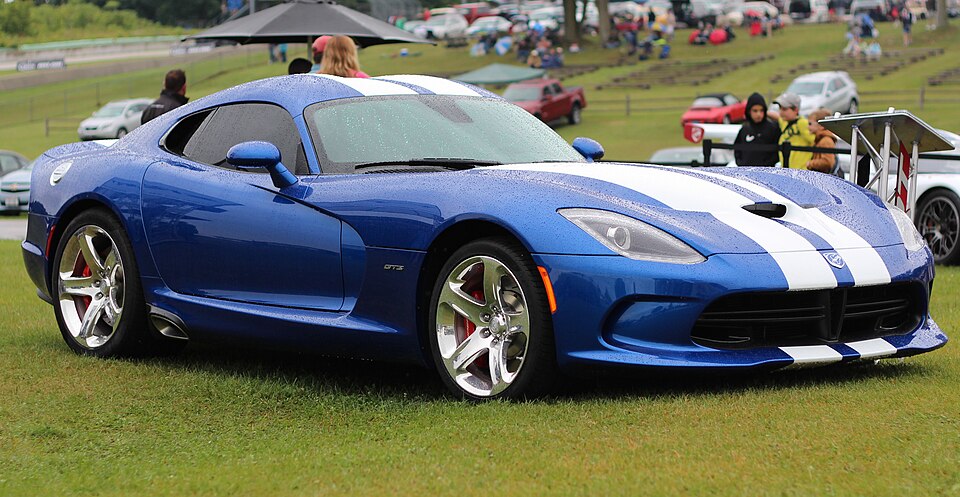
Dodge Viper
8 model years from 2005 to 2017, compared on size, efficiency, safety and reliability.
- Model years
- 2005–2017
- Class
- Two Seaters
- Latest engines
- 8.4L 10-cyl
- Best MPG
- 13–16 combined, by year
- Latest rating
- Not rated
- Recalls
- 5 campaigns, all years
- Most complaints
- 2006 (5)
- Fewest problems
- 2017
- Interest
- 26,153 Wikipedia views / 30 days
The 2017 Viper in brief
The 2017 Dodge Viper is a two seaters offered with a 8.4L 10-cyl engine and rear-wheel drive.
It measures about 176 inches long and 76 inches wide on a 99-inch wheelbase, with a curb weight of roughly 3,300 lb.
EPA rates its most efficient version at 14 MPG combined (12 city / 19 highway), 31% worse than the 2017 two seaters average of 20.3 MPG, for an estimated $5,850 a year in fuel.
NHTSA has not published a 5-Star overall rating for this model year.
There are no recalls or owner complaints on file with NHTSA for this model year.
The Dodge Viper has 8 model years in our data, from 2005 to 2017.
Its most efficient year was 2010 at 16 MPG combined; across all years the best version ranged from 13 to 16 MPG.
Owners most often report problems with the air bags (5), electrical system (4), structure › body (2).
Buying used? 2017 has the fewest problems in our data, and 2016 is the year to avoid.
2016 has the most recalls (2); all years together count 5 campaigns and 13 owner complaints.
How the 2005 Viper compares
The 2005 Dodge Viper is a two seaters offered with a 8.3L 10-cyl engine and rear-wheel drive.
It measures about 174 inches long and 75 inches wide on a 98-inch wheelbase, with a curb weight of roughly 3,408 lb.
About the Dodge Viper
The Dodge Viper is an American sports car that was manufactured by Dodge, a division of American car manufacturer Chrysler. First showcased in 1989 at the North American International Auto Show as a interpretative concept car of a modern-era AC Cobra, production of the two-seat sports car later began at New Mack Assembly Plant in 1991 and moved to Conner Avenue Assembly Plant in October 1995. Five generations of the Viper were developed from 1991 until 2017, with a brief hiatus in 2007 and between 2011 and 2012.
From the Wikipedia article "Dodge Viper", licensed under CC BY-SA 4.0.
2017 Viper pros & cons
Full 2017 details →What's good
- No recalls so far
Watch out for
- Below-average fuel economyBest version gets 14 MPG combined, 31% below the 2017 two seaters average of 20.3 MPG.
- Premium fuel requiredEvery gasoline version is rated for premium, which raises running costs.
Best and worst years to buy used
2017 Viper
0 owner complaints · 0 recalls
Year to avoid2016 Viper
0 owner complaints · 2 recalls
NHTSA recalls and complaints for 3 model years since 2015; use it alongside a pre-purchase inspection. How we calculate this →
Viper changes by model year
- 2008
- Engine added: 8.4L 10-cyl
- Engine dropped: 8.3L 10-cyl
- Best combined MPG up from 13 to 16
Years without a measurable change are left out.
Show all 8 model years side by side
| Year | Latest engines | Best MPG / range | Length | Weight | Overall | Recalls | Complaints |
|---|---|---|---|---|---|---|---|
| 2017 | 8.4L 10-cyl | 14 MPG | 175.6 in | 3,300 lb | Not rated | 0 | 0 |
| 2016 | 8.4L 10-cyl | 15 MPG | 175.6 in | 3,300 lb | Not rated | 2 | 0 |
| 2015 | 8.4L 10-cyl | 15 MPG | 175.6 in | 3,300 lb | Not rated | 1 | 3 |
| 2010 | 8.4L 10-cyl | 16 MPG | 175.6 in | 3,448 lb | Not rated | 0 | 0 |
| 2009 | 8.4L 10-cyl | 16 MPG | 175.6 in | 3,448 lb | Not rated | 0 | 0 |
| 2008 | 8.4L 10-cyl | 16 MPG | 175.6 in | 3,448 lb | Not rated | 0 | 0 |
| 2006 | 8.3L 10-cyl | 13 MPG | 174.4 in | 3,408 lb | Not rated | 2 | 5 |
| 2005 | 8.3L 10-cyl | 13 MPG | 174.4 in | 3,408 lb | Not rated | 1 | 5 |
Alternatives to the 2006 Viper
| Model | Best MPG / range | NHTSA overall | Recalls |
|---|---|---|---|
| 2006 Chevrolet Corvette | 19 MPG | Not rated | 2 |
| 2006 Ford GT | 14 MPG | Not rated | 4 |
| 2006 Spyker C8 | 15 MPG | Not rated | 0 |
Most common owner-reported problems
Sources: EPA, NHTSA, Transport Canada, Wikipedia, Wikimedia Commons. Not affiliated with NHTSA, the EPA or Dodge. How we calculate this →