 DecodedCars
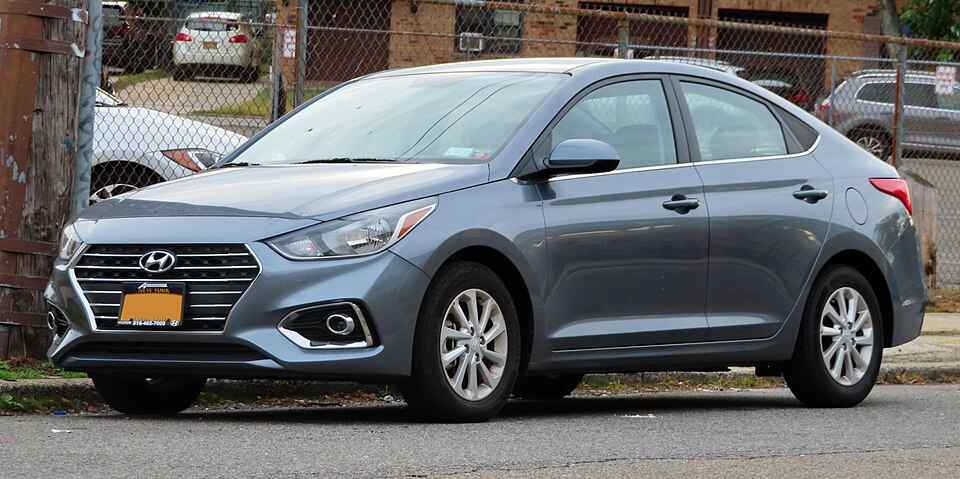
2015 Hyundai Accent
Trims, performance, features, fuel economy, safety and known problems — with the pros and cons against similar 2015 models.
- Class
- Compact Cars
- Body styles
- 4dr Hatchback Gl/Se/Gls (Auto), 4dr Hatchback L/Gl/Gls (Manual), 4dr Sedan Gl/Se/Gls (Auto), 4dr Sedan L (Manual)
- Engines
- 1.6L 4-cyl
- Drivetrain
- Front-Wheel Drive
- Fuel
- Regular Gasoline
- MPG (best)
- 31 combined · 27 city / 37 hwy
- Length
- 162.2–172 in
- Curb weight
- 2,480–2,555 lb
- NHTSA rating
- ★★★★★
- Recalls
- 2 campaigns
Pros & cons
What's good
- Excellent fuel economyUp to 31 MPG combined — 18% better than the average 2015 compact car (26.3 MPG).
Watch out for
- "Park outside" recallCheck that the recall repair was done before buying or driving.
Calculated from EPA, NHTSA and vPIC data against 13 similar 2015 models — not a review. How we calculate this →
Overview
The 2015 Hyundai Accent is a compact car offered with a 1.6L 4-cyl engine and front-wheel drive.
It measures about 162 inches long and 67 inches wide on a 101-inch wheelbase, with a curb weight of roughly 2,555 lb (4dr Hatchback Gl/Se/Gls (Auto)).
EPA rates its most efficient version at 31 MPG combined (27 city / 37 highway), 18% better than the 2015 compact car average of 26.3 MPG, for an estimated $2,150 a year in fuel.
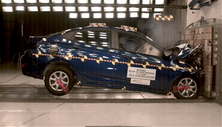
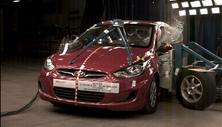
In NHTSA crash testing it earned a 4-star overall rating.
It has 2 recall campaigns on file and owners have filed 70 complaints with NHTSA since 2015, most often about the air bags.
What changed for 2015
No changes to engines, powertrains, drivetrains, size, EPA ratings or NHTSA crash rating compared with the 2014 Accent — a carry-over year in the data.
Compared with 2014; trim, feature and price changes aren't covered. See the 2014 Accent →
Dimensions & weight
| Body | Length | Width | Height | Wheelbase | Track F / R | Curb weight | Weight F/R |
|---|---|---|---|---|---|---|---|
| 4dr Hatchback Gl/Se/Gls (Auto) | 162.2 in | 66.9 in | 57.1 in | 101.2 in | 58.7 / 58.7 in | 2,555 lb | 62/38 |
| 4dr Hatchback L/Gl/Gls (Manual) | 162.2 in | 66.9 in | 57.1 in | 101.2 in | 58.7 / 58.7 in | 2,489 lb | 62/38 |
| 4dr Sedan Gl/Se/Gls (Auto) | 172 in | 67.7 in | 57.1 in | 101.2 in | 58.7 / 59.1 in | 2,546 lb | 62/38 |
| 4dr Sedan L (Manual) | 172 in | 67.7 in | 57.1 in | 101.2 in | 58.7 / 59.1 in | 2,480 lb | 62/38 |
Transport Canada CVS (Open Government Licence – Canada), Canadian-market figures.
Will it fit your garage? Check with your measurements →Engines, MPG & running costs
| Version | Engine | Transmission | Drive | City / Hwy / Comb | vs. class | Fuel / yr | CO₂ g/mi |
|---|---|---|---|---|---|---|---|
| Accent | 1.6L 4-cyl | Manual 6-spd | Front-Wheel Drive | 27 / 37 / 31 | +18% | $2,150 | 285 |
| Accent | 1.6L 4-cyl | Automatic (S6) | Front-Wheel Drive | 26 / 36 / 30 | +14% | $2,250 | 295 |
EPA estimates; "vs. class" is combined MPG against the 2015 EPA class average. How we calculate this →
Safety ratings & technology
| Version | Overall | Frontal | Driver / passenger | Side | Side pole | Rollover | Rollover risk |
|---|---|---|---|---|---|---|---|
| 2015 Hyundai Accent 4 DR FWD | ★★★★★ | ★★★★★ | 5★ / 4★ | ★★★★★ | ★★★★★ | ★★★★★ | 12.4% |
Similar 2015 compact cars
| Model | Best MPG / range | NHTSA overall | Recalls |
|---|---|---|---|
| 2015 Hyundai Accent (this car) | 31 MPG | ★★★★★ | 2 |
| 2015 Mazda 3 | 33 MPG | Not rated | 0 |
| 2015 Volkswagen Golf/GTI | 35 MPG | ★★★★★ | 12 |
| 2015 Subaru Impreza/Outback Sport | 31 MPG | Not rated | 0 |
| 2015 Toyota Yaris | 33 MPG | ★★★★★ | 4 |
| 2015 Ford Focus | 34 MPG | ★★★★★ | 11 |
| 2015 Ford Fiesta | 35 MPG | ★★★★★ | 4 |
Recalls (2)
Service Brakes, Hydraulic › Antilock/Traction Control/Electronic Limited Slip › Control Unit/Module · Sep 22, 2023 Park outside
NHTSA campaign 23V651000 · 1,649,478 vehicles
- Problem
- Hyundai Motor America (Hyundai) is recalling certain 2011-2015 Elantra, Genesis Coupe, Sonata Hybrid, 2012-2015 Accent, Azera, Veloster, 2013-2015 Elantra Coupe, Santa Fe, 2014-2015 Equus, 2010-2012 Veracruz, 2010-2013 Tucson, 2015 Tucson Fuel Cell, and 2013 Santa Fe Sport vehicles. The Anti-Lock Brake System (ABS) module may leak brake fluid internally and cause an electrical short, which can result in an engine compartment fire while parked or driving.
- Risk
- An engine compartment fire while parked or driving can increase the risk of injury.
- Fix
- Owners are advised to park outside and away from structures until the recall repair is complete. Dealers will replace the ABS fuse, free of charge. Owner notification letters were mailed April 10, 2024 through October 11, 2024. Owners may contact Hyundai customer service at 1-855-371-9460. Hyundai's number for this recall is 251.
Air Bags › Frontal · Apr 13, 2015
NHTSA campaign 15V218000 · 2,580 vehicles
- Problem
- Hyundai Motor America (Hyundai) is recalling certain model year 2015 Accent vehicles manufactured September 15, 2014, to February 10, 2015. In very cold temperatures, the occupant detection system (ODS) may not be able to determine if a child restraint seat is in the front passenger seat.
- Risk
- If the ODS fails to detect that the seat is occupied by a child restraint seat, the front air bag will not be deactivated and, in the event of a crash necessitating front air bag deployment, the air bag deployment could cause increased risk of injury to the occupant in the child restraint seat.
- Fix
- Hyundai will notify owners, and dealers will correct ODS software, free of charge. The recall began on June 4, 2015. Owners may contact Hyundai customer service at 1-855-671-3059. Hyundai's number for this recall is 129.
Not every 2015 Hyundai Accent is affected — only a VIN check confirms your car.
Owner-reported problems
Unverified owner reports; best-sellers collect more.
Used 2015 Hyundai Accent buyer's checklist
- Run the VIN at nhtsa.gov/recalls. 2 recalls this year — ask for proof of repairs.
- Safety-critical recall. At least one recall carries a "Do Not Drive" or "Park Outside" warning. Do not buy until the VIN shows it was repaired.
- Air Bags — 26 owner reports. Confirm the airbag warning light turns off after start-up and any airbag recall was completed.
- Engine — 20 owner reports. Cold-start the engine, listen for knocking, and watch for warning lights or hesitation on acceleration.
- Electrical System — 10 owner reports. Test every window, lock, light, screen and USB port; check the battery age.
- Mileage to watch. Owners typically reported problems around 63,589 miles; ask what was repaired near that point.
- Before you pay: service records, a history report and an independent inspection.
Generated by DecodedCars from NHTSA recalls and owner complaints for the 2015 Hyundai Accent. Not a substitute for a professional inspection.
Other Accent years
Compare all years →| Year | MPG (best) | Length | Overall | Recalls | Complaints |
|---|---|---|---|---|---|
| 2022 Accent | 36 | – | ★★★★★ | 2 | 17 |
| 2021 Accent | 36 | – | ★★★★★ | 4 | 16 |
| 2020 Accent | 36 | 172.8 in | ★★★★★ | 4 | 12 |
| 2019 Accent | 32 | 172.8 in | Not rated | 1 | 31 |
| 2018 Accent | 32 | 172.8 in | Not rated | 1 | 19 |
| 2017 Accent | 31 | 162.2 in | ★★★★★ | 0 | 68 |
| 2016 Accent | 31 | 162.2 in | ★★★★★ | 0 | 102 |
| 2014 Accent | 31 | 162.2 in | ★★★★★ | 1 | 79 |
| 2013 Accent | 32 | 162.2 in | Not rated | 1 | 117 |
| 2012 Accent | 32 | 162.2 in | Not rated | 2 | 121 |
| 2011 Accent | 30 | 159.4 in | Not rated | 1 | 23 |
| 2010 Accent | 31 | 159.4 in | Not rated | 1 | 41 |
Sources: EPA, NHTSA, Transport Canada, Wikimedia Commons. Not affiliated with NHTSA, the EPA or Hyundai. How we calculate this →