 DecodedCars
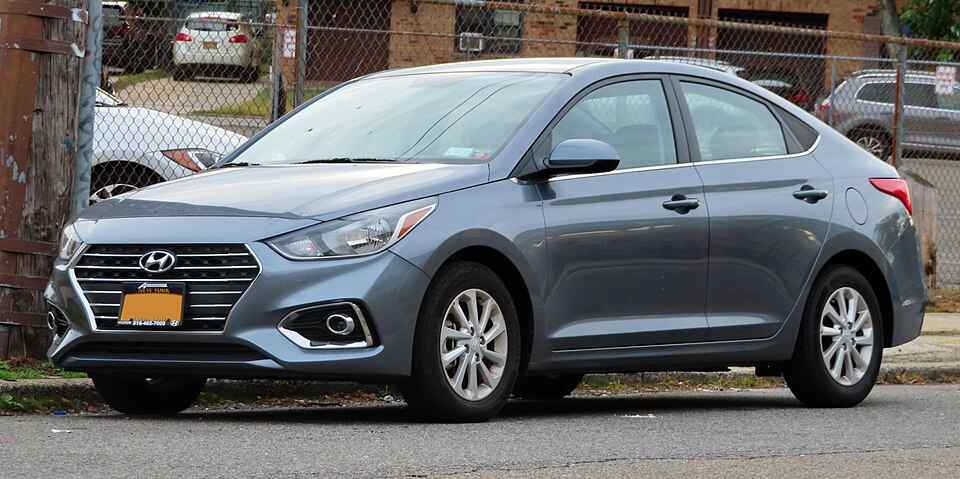
Hyundai Accent
17 model years from 2006 to 2022, compared on size, efficiency, safety and reliability.
- Model years
- 2006–2022
- Class
- Compact Cars
- Latest engines
- 1.6L 4-cyl
- Best MPG
- 29–36 combined, by year
- Latest rating
- ★★★★★ (2022)
- Recalls
- 11 campaigns, all years
- Most complaints
- 2012 (121)
- Fewest problems
- 2018
- Interest
- 11,933 Wikipedia views / 30 days
The 2022 Accent in brief
The 2022 Hyundai Accent is a compact car offered with a 1.6L 4-cyl engine and front-wheel drive.
EPA rates its most efficient version at 36 MPG combined (33 city / 41 highway), 28% better than the 2022 compact car average of 28.2 MPG, for an estimated $1,850 a year in fuel.
In NHTSA crash testing it earned a 4-star overall rating.
It has 2 recall campaigns on file and owners have filed 17 complaints with NHTSA since 2015, most often about the electrical system.
The Hyundai Accent has 17 model years in our data, from 2006 to 2022.
Its most efficient year was 2022 at 36 MPG combined; across all years the best version ranged from 29 to 36 MPG.
Owners most often report problems with the engine (226), air bags (187), unknown or other (114).
Buying used? 2019 has the fewest problems in our data, and 2015 is the year to avoid.
2021 has the most recalls (4); all years together count 11 campaigns and 845 owner complaints.
How the 2006 Accent compares
The 2006 Hyundai Accent is a compact car offered with a 1.6L 4-cyl engine and front-wheel drive.
It measures about 168 inches long and 66 inches wide on a 96-inch wheelbase, with a curb weight of roughly 2,198 lb (5 4dr Hatch FWD).
About the Hyundai Accent
The Hyundai Accent, or Hyundai Verna is a subcompact car produced by Hyundai. In Australia, the first generation models carried over the Hyundai Excel name used by the Accent's predecessor. The Accent was replaced in 2000 by the Hyundai Verna in South Korea, although most international markets, including the US, retained the "Accent" name. The "Accent" name is an acronym of Advanced Compact Car of Epoch-making New Technology.
From the Wikipedia article "Hyundai Accent", licensed under CC BY-SA 4.0.
2022 Accent pros & cons
Full 2022 details →What's good
- Excellent fuel economyUp to 36 MPG combined — 28% better than the average 2022 compact car (28.2 MPG).
Watch out for
No weak spots against similar models in the data.
Best and worst years to buy used
2019 Accent
31 owner complaints · 1 recall · 1 fire report · 2 crash reports
Year to avoid2015 Accent
70 owner complaints · 2 recalls · 11 fire reports · 7 crash reports
Most reported: Air Bags
NHTSA recalls and complaints for 8 model years since 2015; use it alongside a pre-purchase inspection. How we calculate this →
Accent changes by model year
- 2020
- Best combined MPG up from 32 to 36
- Now crash-tested by NHTSA: 4 stars overall
- 2018
- New body dimensions: 10.6 in longer — most likely a redesign or new generation
- 2012
- New body dimensions: 2.8 in longer, wheelbase +2.8 in — most likely a redesign or new generation
- Best combined MPG up from 30 to 32
- 2010
- Best combined MPG up from 29 to 31
- 2007
- New body dimensions: 8.3 in shorter, wheelbase +2.3 in — most likely a redesign or new generation
Years without a measurable change are left out.
Show all 17 model years side by side
| Year | Latest engines | Best MPG / range | Length | Weight | Overall | Recalls | Complaints |
|---|---|---|---|---|---|---|---|
| 2022 | 1.6L 4-cyl | 36 MPG | – | – | ★★★★★ | 2 | 17 |
| 2021 | 1.6L 4-cyl | 36 MPG | – | – | ★★★★★ | 4 | 16 |
| 2020 | 1.6L 4-cyl | 36 MPG | 172.8 in | 2,685 lb | ★★★★★ | 4 | 12 |
| 2019 | 1.6L 4-cyl | 32 MPG | 172.8 in | 2,685 lb | Not rated | 1 | 31 |
| 2018 | 1.6L 4-cyl | 32 MPG | 172.8 in | 2,685 lb | Not rated | 1 | 19 |
| 2017 | 1.6L 4-cyl | 31 MPG | 162.2 in | 2,555 lb | Not rated | 0 | 68 |
| 2016 | 1.6L 4-cyl | 31 MPG | 162.2 in | 2,489 lb | Not rated | 0 | 102 |
| 2015 | 1.6L 4-cyl | 31 MPG | 162.2 in | 2,555 lb | Not rated | 2 | 70 |
| 2014 | 1.6L 4-cyl | 31 MPG | 162.2 in | 2,635 lb | Not rated | 1 | 79 |
| 2013 | 1.6L 4-cyl | 32 MPG | 162.2 in | 2,575 lb | Not rated | 1 | 117 |
| 2012 | 1.6L 4-cyl | 32 MPG | 162.2 in | 2,575 lb | Not rated | 2 | 121 |
| 2011 | 1.6L 4-cyl | 30 MPG | 159.4 in | 2,333 lb | Not rated | 1 | 23 |
| 2010 | 1.6L 4-cyl | 31 MPG | 159.4 in | 2,333 lb | Not rated | 1 | 41 |
| 2009 | 1.6L 4-cyl | 29 MPG | 159.4 in | 2,366 lb | Not rated | 2 | 49 |
| 2008 | 1.6L 4-cyl | 29 MPG | 159.4 in | 2,366 lb | Not rated | 1 | 34 |
| 2007 | 1.6L 4-cyl | 29 MPG | 159.4 in | 2,366 lb | Not rated | 1 | 37 |
| 2006 | 1.6L 4-cyl | 29 MPG | 167.7 in | 2,198 lb | Not rated | 1 | 9 |
Alternatives to the 2022 Accent
| Model | Best MPG / range | NHTSA overall | Recalls |
|---|---|---|---|
| 2022 Toyota Corolla | 52 MPG | ★★★★★ | 0 |
| 2022 Mazda 3 | 31 MPG | Not rated | 0 |
| 2022 Mitsubishi Mirage | 39 MPG | ★★★★★ | 0 |
| 2022 Volkswagen Jetta | 35 MPG | ★★★★★ | 1 |
| 2022 Volkswagen GLI | 30 MPG | Not rated | 0 |
| 2022 Toyota C-HR | 29 MPG | ★★★★★ | 0 |
Most common owner-reported problems
Sources: EPA, NHTSA, Transport Canada, Wikipedia, Wikimedia Commons. Not affiliated with NHTSA, the EPA or Hyundai. How we calculate this →