 DecodedCars
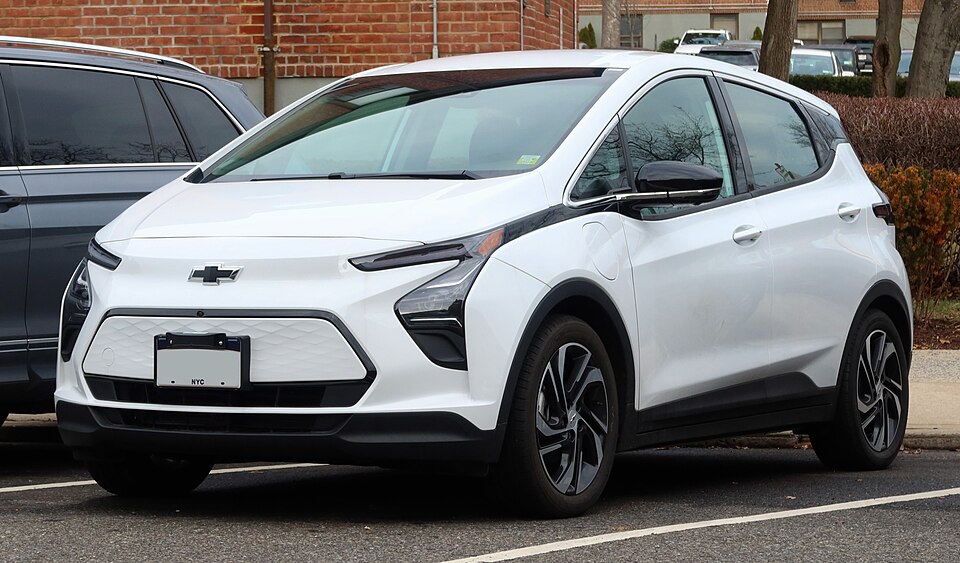
2017 Chevrolet Bolt EV
Trims, performance, features, fuel economy, safety and known problems — with the pros and cons against similar 2017 models.
- Class
- Small Station Wagons
- Engines
- Electric motor
- Drivetrain
- Front-Wheel Drive
- Fuel
- EV
- EV range
- 238 mi · 9.3 h on 240 V
- Length
- –
- Curb weight
- –
- NHTSA rating
- Not rated
- Recalls
- 4 campaigns
Pros & cons
What's good
Nothing stands out against similar models in the data.
Watch out for
- Many owner complaints349 complaints filed with NHTSA versus about 101 for similar models — most often about the steering.
- "Park outside" recallCheck that the recall repair was done before buying or driving.
Calculated from EPA, NHTSA and vPIC data against 6 similar 2017 models — not a review. How we calculate this →
Overview
The 2017 Chevrolet Bolt EV is a small station wagon powered by electricity and front-wheel drive.
The electric version has an EPA-rated range of up to 238 miles and takes about 9.3 hours to charge on a 240-volt Level 2 charger.
NHTSA has not published a 5-Star overall rating for this model year.
It has 4 recall campaigns on file and owners have filed 349 complaints with NHTSA since 2015, most often about the steering.
Engines, MPG & running costs
| Version | Engine | Transmission | Drive | City / Hwy / Comb | vs. class | Fuel / yr | CO₂ g/mi |
|---|---|---|---|---|---|---|---|
| Bolt EV EV | 150 kW ACPM | Automatic (A1) | Front-Wheel Drive | 238 mi · 28.3007 kWh/100mi | – | $650 | – |
EPA estimates; "vs. class" is combined MPG against the 2017 EPA class average. How we calculate this →
Safety ratings & technology
NHTSA has not published 5-Star ratings for the 2017 Chevrolet Bolt EV.
Similar 2017 small station wagons
| Model | Best MPG / range | NHTSA overall | Recalls |
|---|---|---|---|
| 2017 Chevrolet Bolt EV (this car) | 238 mi | Not rated | 4 |
| 2017 Honda Fit | 36 MPG | Not rated | 0 |
| 2017 Honda HR-V | 31 MPG | Not rated | 0 |
| 2017 Kia Niro | 50 MPG | Not rated | 5 |
| 2017 Nissan Juke | 29 MPG | Not rated | 1 |
| 2017 Kia Soul | 28 MPG | Not rated | 3 |
| 2017 Fiat 500 L | 25 MPG | Not rated | 0 |
Recalls (4)
Seat Belts › Pretensioner · Dec 14, 2023
NHTSA campaign 23V845000 · 6,771 vehicles
- Problem
- General Motors, LLC (GM) is recalling certain 2017-2023 Chevrolet Bolt EV vehicles. This recall includes certain vehicles previously repaired incorrectly under NHTSA recall number 22V-930. After a crash with seat belt pretensioner deployment, the pretensioner exhaust may ignite carpet fibers near the B-pillar, causing a fire.
- Risk
- A fire increases the risk of injury.
- Fix
- Dealers will inspect both front seat belt pretensioners and, if necessary, install metal foil at the carpet near the pretensioner exhaust. Certain vehicles will also need a pretensioner cover installed. Repairs will be performed free of charge. Owner notification letters were mailed January 24, 2024. These vehicles were previously recalled for this same issue under recall number 22V-930 and will need to have the new remedy performed. Owners may contact GM EV Concierge at 1-833-EVCHEVY (1-833-382-4389) (TTY 711 / 1-800-833-2438) or Customer Service at 1-800-222-1020. GM's number for this recall is N232421970.
Seat Belts › Pretensioner · Dec 15, 2022
NHTSA campaign 22V930000 · 111,242 vehicles
- Problem
- General Motors, LLC (GM) is recalling certain 2017-2023 Chevrolet Bolt EV vehicles. After a crash with seat belt pretensioner deployment, the pretensioner exhaust may ignite carpet fibers near the B-pillar, causing a fire.
- Risk
- A vehicle fire can increase the risk of injury.
- Fix
- Dealers will install metal foil at the carpet near the pretensioner exhaust, and install a pretensioner cover as necessary, free of charge. Owner notification letters were mailed between January 23, 2023 and April 25, 2023. Owners may contact Chevrolet customer service at 1-800-222-1020. GM's number for this recall is N222383790.
Electrical System › Propulsion System › Traction Battery · Jul 23, 2021 Park outside
NHTSA campaign 21V560000 · 57,414 vehicles
- Problem
- General Motors LLC (GM) is recalling certain 2017-2019 Chevrolet Bolt EV vehicles previously recalled under NHTSA recall number 20V-701. The high voltage battery could catch fire when charged to full or nearly full capacity.
- Risk
- A battery fire increases the risk of injury.
- Fix
- Owners are advised to take the following interim steps: Activate either the Hill Top Reserve (2017 and 2018 models) or Target Charge Level (2019 models) feature in their vehicle to limit the charge level to 90%, charge their vehicle more frequently, avoid depleting the battery to 70 miles range remaining, park outside after charging, and do not charge the vehicle indoors overnight. Defective battery modules will be replaced by GM, free of charge. Interim notification letters notifying owners of the safety risk were mailed on August 13, 2021. Owner notification letters were mailed on August 13, 2021. Owners may contact the Bolt EV Concierge Team at 1-833-382-4389. GM's number for this recall is N212343880.
Electrical System › Propulsion System › Traction Battery · Nov 13, 2020 Park outside
NHTSA campaign 20V701000 · 50,932 vehicles
- Problem
- General Motors LLC (GM) is recalling all 2017-2018 and certain 2019 Chevrolet Bolt EV vehicles. The high voltage battery could catch fire when charged to full or nearly full capacity.
- Risk
- A battery fire increases the risk of injury.
- Fix
- This recall has been superseded by recall number 21V-560. Vehicles previously repaired under 20V-701 will still need to have the new remedy under recall 21V-560. GM will notify owners, and as an interim repair, beginning on November 17, 2020, dealers will reprogram the hybrid propulsion control module 2 (HPCM2) to limit the full charge to 90%, free of charge. Owners are advised to activate either the Hill Top Reserve (2017 and 2018 models) or Target Charge Level (2019 models) feature in their vehicle to limit the charge level to 90%, or park outside, until the software update is completed. Owners were notified of the interim repair beginning November 17, 2020. The second notice was mailed on May 11, 2021. Owners may contact the Bolt EV Concierge Team at 1-833-382-4389. GM's number for this recall is N202311730.
Not every 2017 Chevrolet Bolt EV is affected — only a VIN check confirms your car.
Owner-reported problems
Unverified owner reports; best-sellers collect more.
Used 2017 Chevrolet Bolt EV buyer's checklist
- Run the VIN at nhtsa.gov/recalls. 4 recalls this year — ask for proof of repairs.
- Safety-critical recall. At least one recall carries a "Do Not Drive" or "Park Outside" warning. Do not buy until the VIN shows it was repaired.
- Steering — 125 owner reports. Turn lock-to-lock while parked and on the road; listen for noises and feel for heavy or loose steering.
- Electrical System — 106 owner reports. Test every window, lock, light, screen and USB port; check the battery age.
- Fuel/Propulsion System — 70 owner reports. Smell for fuel around the car and in the cabin, check that it starts easily when warm, and look at the oil dipstick for a fuel smell or rising level.
- Mileage to watch. Owners typically reported problems around 20,000 miles; ask what was repaired near that point.
- Battery health. Ask for a battery state-of-health report, check the remaining battery warranty, and compare the displayed range at 100% charge with the EPA's 238 miles.
- Before you pay: service records, a history report and an independent inspection.
Generated by DecodedCars from NHTSA recalls and owner complaints for the 2017 Chevrolet Bolt EV. Not a substitute for a professional inspection.
Other Bolt EV years
Compare all years →| Year | MPG (best) | Length | Overall | Recalls | Complaints |
|---|---|---|---|---|---|
| 2023 Bolt EV | 259 mi | 163.4 in | ★★★★★ | 3 | 61 |
| 2022 Bolt EV | 259 mi | 163.4 in | ★★★★★ | 7 | 59 |
| 2021 Bolt EV | 259 mi | – | ★★★★★ | 5 | 67 |
| 2020 Bolt EV | 259 mi | – | ★★★★★ | 8 | 176 |
| 2019 Bolt EV | 238 mi | – | ★★★★★ | 6 | 178 |
| 2018 Bolt EV | 238 mi | – | Not rated | 5 | 89 |
Sources: EPA, NHTSA, Transport Canada, Wikimedia Commons. Not affiliated with NHTSA, the EPA or Chevrolet. How we calculate this →