 DecodedCars
Ferrari California
6 model years from 2009 to 2014, compared on size, efficiency, safety and reliability.
- Model years
- 2009–2014
- Class
- Minicompact Cars, Two Seaters
- Latest engines
- 4.3L 8-cyl
- Best MPG
- 15–16 combined, by year
- Latest rating
- Not rated
- Recalls
- 7 campaigns, all years
- Most complaints
- 2012 (2)
- Interest
- 8,916 Wikipedia views / 30 days
The 2014 California in brief
The 2014 Ferrari California is a minicompact car offered with a 4.3L 8-cyl engine and rear-wheel drive.
It measures about 180 inches long and 75 inches wide on a 105-inch wheelbase, with a curb weight of roughly 3,825 lb.
EPA rates its most efficient version at 16 MPG combined (14 city / 19 highway), 30% worse than the 2014 minicompact car average of 23 MPG, for an estimated $5,150 a year in fuel.
NHTSA has not published a 5-Star overall rating for this model year.
It has 2 recall campaigns on file and owners have filed 1 complaint with NHTSA since 2015, most often about the air bags.
The Ferrari California has 6 model years in our data, from 2009 to 2014, classed as Minicompact Cars, Two Seaters.
Its most efficient year was 2014 at 16 MPG combined; across all years the best version ranged from 15 to 16 MPG.
Owners most often report problems with the air bags (3), vehicle speed control (2), service brakes (1).
2011 has the most recalls (4); all years together count 7 campaigns and 6 owner complaints.
How the 2009 California compares
The 2009 Ferrari California is a minicompact car offered with a 4.3L 8-cyl engine and rear-wheel drive.
It measures about 180 inches long and 75 inches wide on a 105-inch wheelbase, with a curb weight of roughly 3,825 lb.
About the Ferrari California
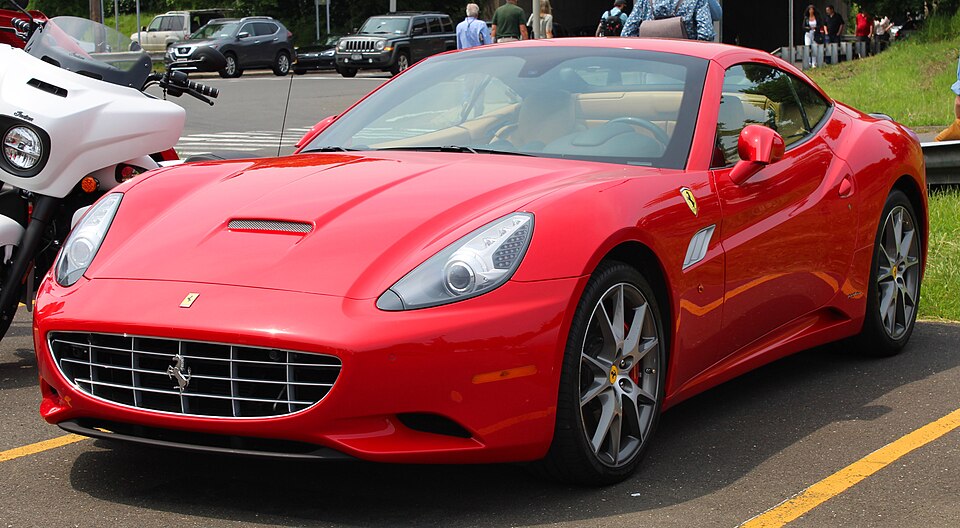
The Ferrari California is a grand touring, high performance sports car created by the Italian automobile manufacturer Ferrari. It is a two-door 2+2 hard top convertible. When originally unveiled in 2008, the California was powered by a front-mid mounted, rear wheel drive, naturally aspirated 4.3-litre V8. In 2012, a lighter, slightly more powerful variant, the California 30, was introduced. In 2014, Ferrari announced the second generation of the model, named California T powered by a new twin-turbo 3.9-litre V8.
From the Wikipedia article "Ferrari California", licensed under CC BY-SA 4.0.
2014 California pros & cons
Full 2014 details →What's good
Nothing stands out against similar models in the data.
Watch out for
- Below-average fuel economyBest version gets 16 MPG combined, 30% below the 2014 minicompact car average of 23 MPG.
- Premium fuel requiredEvery gasoline version is rated for premium, which raises running costs.
California changes by model year
Years without a measurable change are left out.
Show all 6 model years side by side
| Year | Latest engines | Best MPG / range | Length | Weight | Overall | Recalls | Complaints |
|---|---|---|---|---|---|---|---|
| 2014 | 4.3L 8-cyl | 16 MPG | 179.5 in | 3,825 lb | Not rated | 2 | 1 |
| 2013 | 4.3L 8-cyl | 16 MPG | 179.5 in | 3,825 lb | Not rated | 2 | 1 |
| 2012 | 4.3L 8-cyl | 15 MPG | 179.5 in | 4,145 lb | Not rated | 2 | 2 |
| 2011 | 4.3L 8-cyl | 15 MPG | 179.5 in | 3,825 lb | Not rated | 4 | 1 |
| 2010 | 4.3L 8-cyl | 15 MPG | 179.5 in | 3,825 lb | Not rated | 4 | 1 |
| 2009 | 4.3L 8-cyl | 15 MPG | 179.5 in | 3,825 lb | Not rated | 4 | 0 |
Alternatives to the 2014 California
| Model | Best MPG / range | NHTSA overall | Recalls |
|---|---|---|---|
| 2014 Ferrari 458 Spider | 15 MPG | Not rated | 2 |
| 2014 Ferrari 458 Italia | 15 MPG | Not rated | 2 |
| 2014 Lotus Evora | 22 MPG | Not rated | 0 |
| 2014 Aston Martin Vantage | 16 MPG | Not rated | 0 |
Most common owner-reported problems
Sources: EPA, NHTSA, Transport Canada, Wikipedia, Wikimedia Commons. Not affiliated with NHTSA, the EPA or Ferrari. How we calculate this →