 DecodedCars
2025 Genesis GV70
Trims, performance, features, fuel economy, safety and known problems — with the pros and cons against similar 2025 models.

- Class
- Small Sport Utility Vehicle 4WD
- Body styles
- 2.5l 4dr SUV, 3.5l 4dr SUV
- Engines
- 2.5L 4-cyl turbo, 3.5L 6-cyl turbo
- Drivetrain
- All-Wheel Drive
- Fuel
- EV, Premium Gasoline
- MPG (best)
- 24 combined · 22 city / 28 hwy
- EV range
- 236 mi · 7.9 h on 240 V
- Length
- 185.4 in
- Curb weight
- 4,167–4,520 lb
- NHTSA rating
- ★★★★★
- Recalls
- 3 campaigns
Pros & cons
What's good
- Electric version availableOffered as a electric as well as gas.
- 5-star NHTSA safety ratingTop overall score in federal crash tests.
- Lots of standard safety tech5 of 5 key driver aids standard on the versions we checked.
Watch out for
- Premium fuel requiredEvery gasoline version is rated for premium, which raises running costs.
Calculated from EPA, NHTSA and vPIC data against 47 similar 2025 models — not a review. How we calculate this →
Overview
The 2025 Genesis GV70 is a small SUV offered with 2 engines (2.5L 4-cyl turbo and 3.5L 6-cyl turbo) and all-wheel drive.
It measures about 185 inches long and 75 inches wide on a 113-inch wheelbase, with a curb weight of roughly 4,167 lb (2.5l 4dr SUV).
EPA rates its most efficient version at 24 MPG combined (22 city / 28 highway), 6% worse than the 2025 small SUV average of 25.6 MPG, for an estimated $850 a year in fuel.
The electric version has an EPA-rated range of up to 236 miles and takes about 7.9 hours to charge on a 240-volt Level 2 charger.
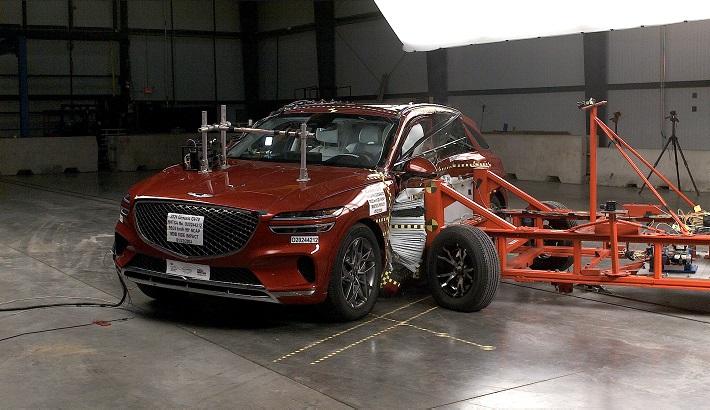
In NHTSA crash testing it earned the top 5-star overall rating.
It has 3 recall campaigns on file and owners have filed 39 complaints with NHTSA since 2015, most often about the electrical system.
What changed for 2025
No changes to engines, powertrains, drivetrains, size, EPA ratings or NHTSA crash rating compared with the 2024 GV70 — a carry-over year in the data.
Compared with 2024; trim, feature and price changes aren't covered. See the 2024 GV70 →
Trims, performance & features
Trims
Safety & driver-assist features
Built in: Montgomery, Alabama · Ul-San, South Korea
NHTSA vPIC, as reported by the manufacturer for 5 2025 GV70 configurations; may not list every trim. How we calculate this →
Dimensions & weight
| Body | Length | Width | Height | Wheelbase | Track F / R | Curb weight | Weight F/R |
|---|---|---|---|---|---|---|---|
| 2.5l 4dr SUV | 185.4 in | 75.2 in | 64.2 in | 113 in | 64.6 / 65.4 in | 4,167 lb | 53/47 |
| 3.5l 4dr SUV | 185.4 in | 75.2 in | 64.2 in | 113 in | 64.6 / 65.4 in | 4,520 lb | 53/47 |
Transport Canada CVS (Open Government Licence – Canada), Canadian-market figures.
Will it fit your garage? Check with your measurements →Engines, MPG & running costs
| Version | Engine | Transmission | Drive | City / Hwy / Comb | vs. class | Fuel / yr | CO₂ g/mi |
|---|---|---|---|---|---|---|---|
| Electrified GV70 EV | 74 and 160 kW PMSM | Automatic (A1) | All-Wheel Drive | 236 mi · 37.1566 kWh/100mi | – | $850 | – |
| GV70 AWD | 2.5L 4-cyl turbo | Automatic (S8) | All-Wheel Drive | 22 / 28 / 24 | -6% | $3,400 | 369 |
| GV70 AWD | 2.5L 4-cyl turbo | Automatic (S8) | All-Wheel Drive | 19 / 26 / 22 | -14% | $3,750 | 408 |
| GV70 AWD | 3.5L 6-cyl turbo | Automatic (S8) | All-Wheel Drive | 18 / 24 / 20 | -22% | $4,100 | 441 |
EPA estimates; "vs. class" is combined MPG against the 2025 EPA class average. How we calculate this →
Safety ratings & technology
| Version | Overall | Frontal | Driver / passenger | Side | Side pole | Rollover | Rollover risk |
|---|---|---|---|---|---|---|---|
| 2025 Genesis GV70 SUV AWD | ★★★★★ | ★★★★★ | 4★ / 5★ | ★★★★★ | ★★★★★ | ★★★★★ | 13% |

Similar 2025 small SUVs
| Model | Best MPG / range | NHTSA overall | Recalls |
|---|---|---|---|
| 2025 Genesis GV70 (this car) | 24 MPG | ★★★★★ | 3 |
| 2025 Mercedes-Benz G-Class | 18 MPG | Not rated | 0 |
| 2025 Tesla Model Y | 337 mi | ★★★★★ | 3 |
| 2025 Porsche Cayenne | 22 MPG | Not rated | 2 |
| 2025 BMW X5 | 25 MPG | ★★★★★ | 5 |
| 2025 Land Rover Defender | 19 MPG | Not rated | 1 |
| 2025 BMW X3 | 29 MPG | ★★★★★ | 9 |
Recalls (3)
Fuel System, Gasoline › Delivery › Hoses, Lines/Piping, And Fittings · Apr 10, 2026
NHTSA campaign 26V229000 · 94,760 vehicles
- Problem
- Hyundai Motor America (Genesis) is recalling certain Genesis 2022-2026 GV70, 2023-2025 G90, 2021-2025 G80, and GV80 vehicles. Fuel may leak at the pipe connection between the fuel pipe and fuel rail.
- Risk
- A fuel leak increases the risk of a fire.
- Fix
- Dealers will inspect and tighten, or replace the fuel pipe as necessary, free of charge. Owner notification letters were mailed beginning July 20, 2026. Owners may contact Genesis customer service at 844-340-9741. Genesis' number for this recall is 033G. Vehicle Identification Numbers (VINs) involved in this recall became searchable on NHTSA.gov beginning April 11, 2026.
Electrical System › Instrument Cluster/Panel · Feb 19, 2025
NHTSA campaign 25V105000 · 32,594 vehicles
- Problem
- Hyundai Motor America (Hyundai) is recalling certain Genesis 2023-2024 G80, GV80, 2025 GV70 and 2023-2025 GV70 "Electrified" vehicles. Due to a software error, the instrument panel display may fail. As such, these vehicles fail to comply with the requirements of Federal Motor Vehicle Safety Standard (FMVSS) number 101, "Controls and Displays."
- Risk
- An instrument panel display that fails to show critical safety information, such as the speedometer or warning lights, increases the risk of a crash.
- Fix
- Dealers will inspect and update the instrument panel display software, as necessary, free of charge. Owner notification letters were mailed March 26, 2025. Owners may contact Genesis customer service at 844-340-9741. Hyundai's number for this recall is 026G.
Electrical System › Propulsion System › Charging › Module › Software · Nov 18, 2024
NHTSA campaign 24V868000 · 145,642 vehicles
- Problem
- Hyundai Motor America (Hyundai) is recalling certain 2022-2024 IONIQ 5, 2023-2025 IONIQ 6, Genesis GV60, Genesis GV70 "Electrified," and Genesis G80 "Electrified" vehicles. The Integrated Charging Control Unit (ICCU) may become damaged and stop charging the 12-volt battery, which can result in a loss of drive power.
- Risk
- A loss of drive power increases the risk of a crash.
- Fix
- Dealers will inspect and replace the ICCU and its fuse, as necessary. In addition, dealers will update the ICCU software. All repairs will be performed free of charge. Owner notification letters were mailed December 20, 2024. Owners may contact Hyundai customer service at 1-855-371-9460 or Genesis customer service at 1-844-340-9741. Hyundai's numbers for this recall are 272 (Hyundai) and 025G (Genesis). This recall expands and replaces previous recall number 24V-204. Vehicles previously repaired under recall 24V-204 will need to have the new remedy completed.
Not every 2025 Genesis GV70 is affected — only a VIN check confirms your car.
Owner-reported problems
Unverified owner reports; best-sellers collect more.
Used 2025 Genesis GV70 buyer's checklist
- Run the VIN at nhtsa.gov/recalls. 3 recalls this year — ask for proof of repairs.
- Electrical System — 12 owner reports. Test every window, lock, light, screen and USB port; check the battery age.
- Engine — 9 owner reports. Cold-start the engine, listen for knocking, and watch for warning lights or hesitation on acceleration.
- Forward Collision Avoidance › Automatic Emergency Braking — 9 owner reports. Make sure driver-assist systems and the backup camera work without error messages.
- Mileage to watch. Owners typically reported problems around 11,475 miles; ask what was repaired near that point.
- Battery health. Ask for a battery state-of-health report, check the remaining battery warranty, and compare the displayed range at 100% charge with the EPA's 236 miles.
- Before you pay: service records, a history report and an independent inspection.
Generated by DecodedCars from NHTSA recalls and owner complaints for the 2025 Genesis GV70. Not a substitute for a professional inspection.
Other GV70 years
Compare all years →Sources: EPA, NHTSA, Transport Canada, Wikimedia Commons. Not affiliated with NHTSA, the EPA or Genesis. How we calculate this →