 DecodedCars
2025 Hyundai Kona
Trims, performance, features, fuel economy, safety and known problems — with the pros and cons against similar 2025 models.
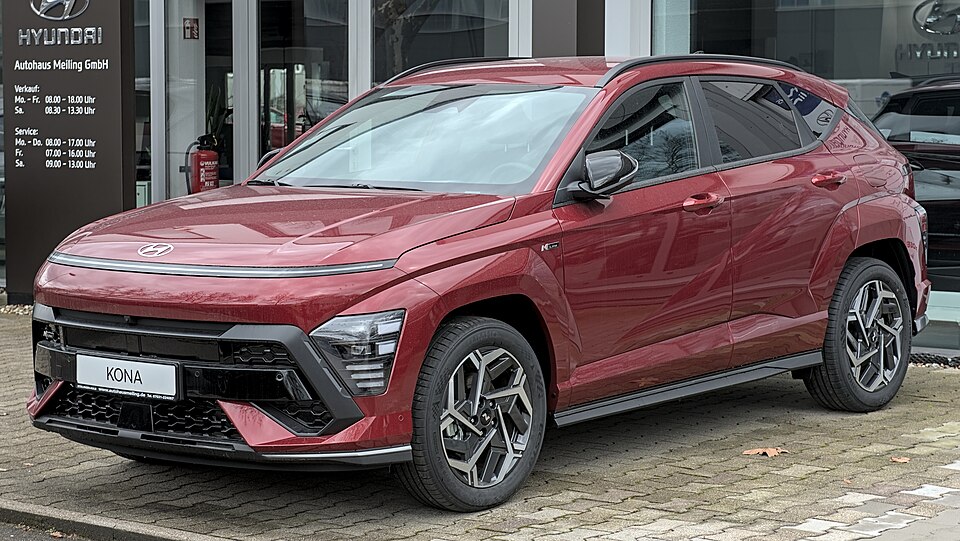
- Class
- Small Sport Utility Vehicle 2WD
- Body styles
- 4dr SUV AWD, 4dr SUV FWD, Electric 4dr SUV, N-Series 4dr SUV
- Engines
- 2.0L 4-cyl, 1.6L 4-cyl turbo
- Drivetrain
- Front-Wheel Drive, All-Wheel Drive
- Fuel
- EV, Regular Gasoline
- MPG (best)
- 31 combined · 29 city / 35 hwy
- EV range
- 261 mi · 5.1 h on 240 V
- Length
- 171.3–172.8 in
- Curb weight
- 3,005–3,759 lb
- NHTSA rating
- Not rated
- Recalls
- 1 campaign
Pros & cons
What's good
- Electric version availableOffered as a electric as well as gas.
- AWD / 4WD available
- Lots of standard safety tech4 of 5 key driver aids standard on the versions we checked.
Watch out for
No weak spots against similar models in the data.
Calculated from EPA, NHTSA and vPIC data against 21 similar 2025 models — not a review. How we calculate this →
Overview
The 2025 Hyundai Kona is a small SUV offered with 2 engines (2.0L 4-cyl and 1.6L 4-cyl turbo) and front-wheel drive and all-wheel drive.
It measures about 171 inches long and 72 inches wide on a 105-inch wheelbase, with a curb weight of roughly 3,203 lb (4dr SUV AWD).
EPA rates its most efficient version at 31 MPG combined (29 city / 35 highway), 7% better than the 2025 small SUV average of 29 MPG, for an estimated $650 a year in fuel.
The electric version has an EPA-rated range of up to 261 miles and takes about 5.1 hours to charge on a 240-volt Level 2 charger.
NHTSA has not published a 5-Star overall rating for this model year.
It has 1 recall campaign on file and owners have filed 29 complaints with NHTSA since 2015, most often about the electrical system.
What changed for 2025
No changes to engines, powertrains, drivetrains, size, EPA ratings or NHTSA crash rating compared with the 2024 Kona — a carry-over year in the data.
Compared with 2024; trim, feature and price changes aren't covered. See the 2024 Kona →
Trims, performance & features
Trims
Safety & driver-assist features
Built in: Ulsan, South Korea
NHTSA vPIC, as reported by the manufacturer for 5 2025 Kona configurations; may not list every trim. How we calculate this →
Dimensions & weight
| Body | Length | Width | Height | Wheelbase | Track F / R | Curb weight | Weight F/R |
|---|---|---|---|---|---|---|---|
| 4dr SUV AWD | 171.3 in | 71.7 in | 63.4 in | 104.7 in | 62.6 / 63 in | 3,203 lb | 59/41 |
| 4dr SUV FWD | 171.3 in | 71.7 in | 62.2 in | 104.7 in | 62.6 / 63 in | 3,005 lb | 61/39 |
| Electric 4dr SUV | 171.7 in | 71.7 in | 62.2 in | 104.7 in | 62.6 / 63 in | 3,759 lb | 52/48 |
| N-Series 4dr SUV | 172.8 in | 71.7 in | 63.4 in | 104.7 in | 62.6 / 63 in | 3,461 lb |
Transport Canada CVS (Open Government Licence – Canada), Canadian-market figures.
Will it fit your garage? Check with your measurements →Engines, MPG & running costs
| Version | Engine | Transmission | Drive | City / Hwy / Comb | vs. class | Fuel / yr | CO₂ g/mi |
|---|---|---|---|---|---|---|---|
| Kona Electric Standard Range EV | 99 kW PMSM (IPM) | Automatic (A1) | Front-Wheel Drive | 200 mi · 28.5326 kWh/100mi | – | $650 | – |
| Kona Electric (17 inch Wheels) EV | 150 kW PMSM (IPM) | Automatic (A1) | Front-Wheel Drive | 261 mi · 29.0825 kWh/100mi | – | $650 | – |
| Kona Electric (19 inch Wheels) EV | 150 kW PMSM (IPM) | Automatic (A1) | Front-Wheel Drive | 230 mi · 31 kWh/100mi | – | $700 | – |
| Kona FWD | 2.0L 4-cyl | Automatic (AV-S1) | Front-Wheel Drive | 28 / 35 / 31 | +7% | $2,150 | 288 |
| Kona FWD | 2.0L 4-cyl | Automatic (AV-S1) | Front-Wheel Drive | 29 / 34 / 31 | +7% | $2,150 | 284 |
| Kona AWD | 2.0L 4-cyl | Automatic (AV-S1) | All-Wheel Drive | 27 / 29 / 28 | +9% | $2,400 | 319 |
| Kona FWD | 1.6L 4-cyl turbo | Automatic (S8) | Front-Wheel Drive | 26 / 32 / 28 | -3% | $2,400 | 315 |
| Kona AWD | 2.0L 4-cyl | Automatic (AV-S1) | All-Wheel Drive | 26 / 29 / 27 | +5% | $2,500 | 323 |
| Kona AWD | 1.6L 4-cyl turbo | Automatic (S8) | All-Wheel Drive | 24 / 29 / 26 | +2% | $2,600 | 339 |
EPA estimates; "vs. class" is combined MPG against the 2025 EPA class average. How we calculate this →
Safety ratings & technology
NHTSA has not published 5-Star ratings for the 2025 Hyundai Kona.
Similar 2025 small SUVs
| Model | Best MPG / range | NHTSA overall | Recalls |
|---|---|---|---|
| 2025 Hyundai Kona (this car) | 31 MPG | Not rated | 1 |
| 2025 Toyota RAV4 | 39 MPG | ★★★★★ | 4 |
| 2025 Ford Bronco | 20 MPG | Not rated | 19 |
| 2025 Mazda CX-5 | 28 MPG | ★★★★★ | 0 |
| 2025 Kia Seltos | 31 MPG | ★★★★★ | 0 |
| 2025 Toyota Corolla Cross | 42 MPG | ★★★★★ | 1 |
| 2025 Ford Escape | 40 MPG | Not rated | 10 |
Recalls (1)
Seat Belts › Rear/Other › Buckle Assembly · Jul 14, 2026
NHTSA campaign 26V452000 · 47,787 vehicles
- Problem
- Hyundai Motor America (Hyundai) is recalling certain 2024-2025 Kona Electric and 2024-2026 Kona vehicles. The seat belt buckle in the rear center seat may fail to properly restrain an occupant during a crash.
- Risk
- A seat belt buckle that fails to properly restrain an occupant in a crash increases the risk of injury.
- Fix
- Passengers are advised not to use the rear center seat until the recall remedy is performed. Dealers will replace the seat belt buckle assembly, free of charge. Owner notification letters were mailed September 2, 2026. Owners may contact Hyundai customer service at 1-855-371-9460. Hyundai's number for this recall is 306. Vehicle Identification Numbers (VINs) involved in this recall became searchable on NHTSA.gov on July 15, 2026.
Not every 2025 Hyundai Kona is affected — only a VIN check confirms your car.
Owner-reported problems
Unverified owner reports; best-sellers collect more.
Used 2025 Hyundai Kona buyer's checklist
- Run the VIN at nhtsa.gov/recalls. 1 recall this year — ask for proof of repairs.
- Electrical System — 8 owner reports. Test every window, lock, light, screen and USB port; check the battery age.
- Power Train — 4 owner reports. Test-drive through all gears, including reverse; note slipping, harsh or delayed shifts.
- Service Brakes — 4 owner reports. Brake firmly from speed; check for pulling, pulsing pedal or ABS warning light.
- Mileage to watch. Owners typically reported problems around 5,798 miles; ask what was repaired near that point.
- Battery health. Ask for a battery state-of-health report, check the remaining battery warranty, and compare the displayed range at 100% charge with the EPA's 261 miles.
- Before you pay: service records, a history report and an independent inspection.
Generated by DecodedCars from NHTSA recalls and owner complaints for the 2025 Hyundai Kona. Not a substitute for a professional inspection.
Other Kona years
Compare all years →| Year | MPG (best) | Length | Overall | Recalls | Complaints |
|---|---|---|---|---|---|
| 2027 Kona | 31 | – | Not rated | 0 | 0 |
| 2026 Kona | 31 | 171.3 in | Not rated | 3 | 10 |
| 2024 Kona | 31 | 171.3 in | Not rated | 4 | 68 |
| 2023 Kona | 32 | 165.4 in | Not rated | 2 | 75 |
| 2022 Kona | 32 | 165.4 in | Not rated | 2 | 130 |
| 2021 Kona | 30 | 164.2 in | ★★★★★ | 3 | 147 |
| 2020 Kona | 30 | 164.2 in | ★★★★★ | 5 | 189 |
| 2019 Kona | 30 | 164.2 in | ★★★★★ | 4 | 252 |
| 2018 Kona | 30 | 164.2 in | Not rated | 0 | 75 |
Sources: EPA, NHTSA, Transport Canada, Wikimedia Commons. Not affiliated with NHTSA, the EPA or Hyundai. How we calculate this →