 DecodedCars
Chevrolet Bolt EV 2022
Versiones, desempeño, equipamiento, consumo, seguridad y problemas conocidos, con sus ventajas y desventajas frente a modelos similares 2022.
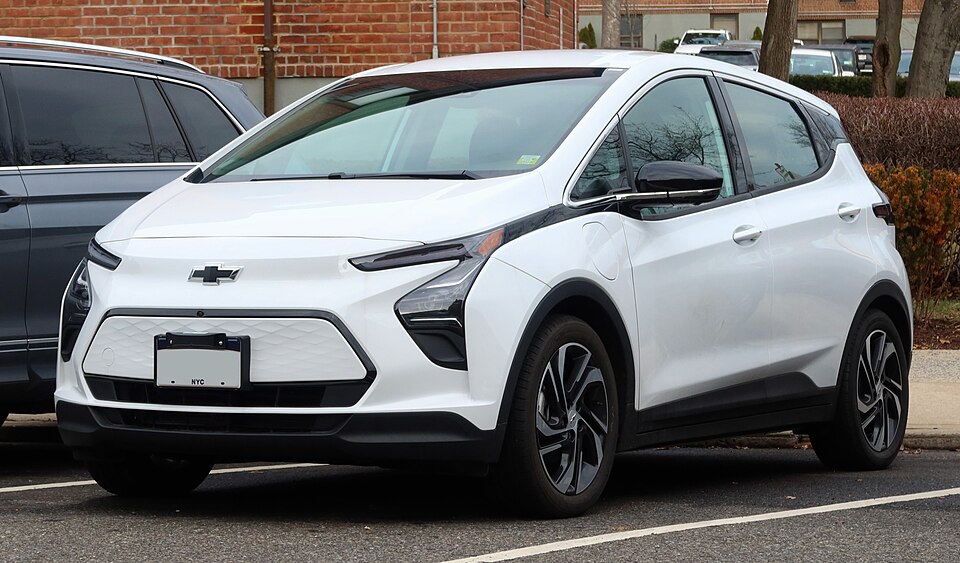
- Clase
- Familiar pequeño
- Carrocerías
- 4dr Hatchback
- Motores
- Motor eléctrico
- Transmisión
- 1-speed Automática
- Tracción
- Tracción delantera
- Asientos
- 5
- Combustible
- Eléctrico
- Autonomía eléctrica
- 259 mi · 7.5 h a 240 V
- Largo
- 163.4 in
- Peso en vacío
- 3,589 lb
- Calificación NHTSA
- ★★★★★
- Retiros
- 7 campañas
Ventajas y desventajas
Lo bueno
- 5 estrellas en seguridad NHTSALa máxima calificación general en las pruebas de choque federales.
A tener en cuenta
- Retiro con aviso de "estacionar afuera"Verifica que la reparación del retiro esté hecha antes de comprarlo o manejarlo.
Calculado con datos de la EPA, la NHTSA y vPIC frente a 5 modelos similares 2022; no es una reseña. Cómo lo calculamos →
Resumen
El Chevrolet Bolt EV 2022 es un familiar pequeño 100 % eléctrico, con tracción delantera.
Mide unas 163 pulgadas de largo y 70 de ancho, con una distancia entre ejes de 102 pulgadas, y pesa alrededor de 3,589 lb.
La versión eléctrica tiene una autonomía EPA de hasta 259 millas y tarda unas 7.5 horas en cargarse con un cargador de nivel 2 (240 V).
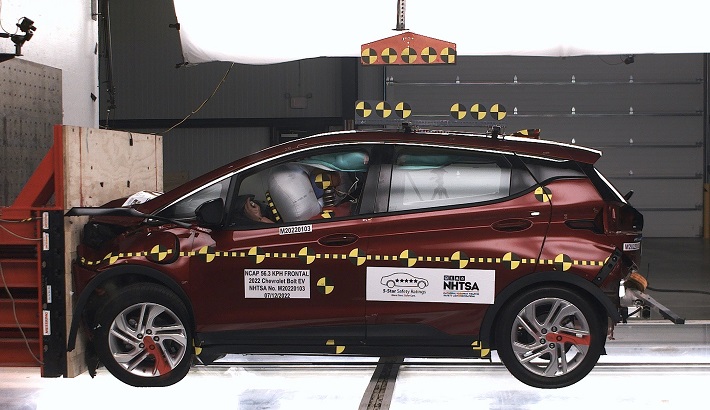
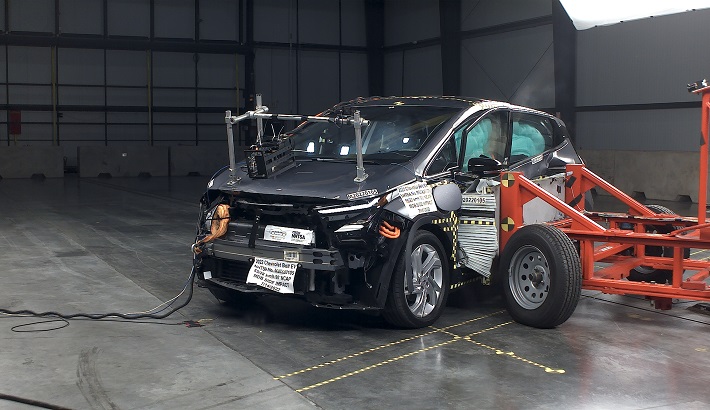
En las pruebas de choque de la NHTSA obtuvo la máxima calificación general de 5 estrellas.
Tiene 7 campañas de retiro registradas y los propietarios han presentado 59 quejas ante la NHTSA desde 2015, sobre todo por problemas de sistema eléctrico.
Novedades del 2022
Sin cambios en motores, versiones, tracción, tamaño, consumo EPA ni calificación NHTSA respecto al Bolt EV 2021: un año sin cambios según los datos.
Comparado con 2021; no incluye cambios de versiones, equipamiento ni precio. Ver el Bolt EV 2021 →
Versiones, desempeño y equipamiento
Versiones
Seguridad y asistencias al conductor
Fabricado en: Orion, Michigan
NHTSA vPIC, según el fabricante, para 4 configuraciones del Bolt EV 2022; puede no incluir todas las versiones. Cómo lo calculamos →
Dimensiones y peso
| Carrocería | Largo | Ancho | Alto | Distancia entre ejes | Vía del. / tras. | Peso en vacío | Peso del./tras. |
|---|---|---|---|---|---|---|---|
| 4dr Hatchback | 163.4 in | 69.7 in | 63.4 in | 102.4 in | 59.1 / 59.1 in | 3,589 lb | 56/44 |
Transport Canada CVS (Open Government Licence – Canada), medidas del mercado canadiense.
¿Cabe en tu garaje? Compruébalo con tus medidas →Motores, consumo y costo de uso
| Versión | Motor | Transmisión | Tracción | Ciudad / Carr. / Comb. | vs. su clase | Combustible / año | CO₂ g/mi |
|---|---|---|---|---|---|---|---|
| Bolt EV Eléctrico | 150 kW ACPM | Automática (relación variable) | Tracción delantera | 259 mi · 28.1083 kWh/100mi | – | $650 | – |
Estimaciones de la EPA; "vs. su clase" compara las MPG combinadas con el promedio 2022 de su clase EPA. Cómo lo calculamos →
Calificaciones de seguridad y tecnología
| Versión | General | Frontal | Conductor / pasajero | Lateral | Poste lateral | Volcadura | Riesgo de volcadura |
|---|---|---|---|---|---|---|---|
| 2022 Chevrolet Bolt EV 5 HB FWD | ★★★★★ | ★★★★★ | 5★ / 4★ | ★★★★★ | ★★★★★ | ★★★★★ | 9.7% |
Familiar pequeño similares 2022
| Modelo | Mejor MPG / autonomía | General NHTSA | Retiros |
|---|---|---|---|
| Chevrolet Bolt EV 2022 (este auto) | 259 mi | ★★★★★ | 7 |
| Honda HR-V 2022 | 30 MPG | ★★★★★ | 3 |
| Kia Niro 2022 | 50 MPG | ★★★★★ | 3 |
| Chevrolet Bolt EUV 2022 | 247 mi | ★★★★★ | 4 |
| Kia Soul 2022 | 31 MPG | ★★★★★ | 1 |
| Nissan Rogue Sport 2022 | 28 MPG | ★★★★★ | 1 |
Retiros (7)
Texto oficial de la NHTSA (en inglés).
Sistema eléctrico › Propulsion System › Traction Battery · 31 oct 2024 Estacionar afuera
Campaña NHTSA 24V812000 · 107 vehículos
- Problema
- General Motors, LLC (GM) is recalling certain 2020-2022 Chevrolet Bolt EV and 2022 Bolt EUV vehicles previously repaired under Recall 21V-650. The installation of advanced diagnostic software may have failed. As such, the high voltage battery could catch fire when charged to full or nearly full capacity.
- Riesgo
- A battery fire increases the risk of injury.
- Solución
- Owners are advised to take the following interim steps: Set the Target Charge Level feature in their vehicle to limit the charge level to 90%, charge their vehicle more frequently, avoid depleting the battery to 70 miles range remaining, park outside after charging, and do not charge the vehicle indoors overnight. Dealers will reinstall advanced diagnostic software, free of charge. Owner notification letters were mailed December 3, 2024. Owners may contact the Bolt EV Concierge Team at 1-833-382-4389. GM's number for this recall is N242470160.
Sistema eléctrico › Propulsion System › Traction Battery · 27 jun 2024 Estacionar afuera
Campaña NHTSA 24V481000 · 72 vehículos
- Problema
- General Motors, LLC (GM) is recalling certain 2020-2022 Chevrolet Bolt EV and 2022 Chevrolet Bolt EUV vehicles that were previously remedied under recall number 21V-650. The advanced diagnostic software may have been incorrectly installed and fail to detect defective battery modules, possibly resulting in a battery fire.
- Riesgo
- A battery fire increases the risk of injury.
- Solución
- Owners are advised to take the following interim steps: Set the Target Charge Level feature in their vehicle to limit the charge level to 90%, charge their vehicle more frequently, avoid depleting the battery to 70 miles range remaining, park outside after charging, and do not charge the vehicle indoors overnight. Dealers will reinstall the advanced diagnostic software, free of charge. Owner notification letters were mailed on August 1, 2024. Owners may contact the Bolt EV Concierge Team at 1-833-382-4389. GM's numbers for this recall are N242443000 and N242443002.
Cinturones de seguridad › Pretensioner · 14 dic 2023
Campaña NHTSA 23V845000 · 6,771 vehículos
- Problema
- General Motors, LLC (GM) is recalling certain 2017-2023 Chevrolet Bolt EV vehicles. This recall includes certain vehicles previously repaired incorrectly under NHTSA recall number 22V-930. After a crash with seat belt pretensioner deployment, the pretensioner exhaust may ignite carpet fibers near the B-pillar, causing a fire.
- Riesgo
- A fire increases the risk of injury.
- Solución
- Dealers will inspect both front seat belt pretensioners and, if necessary, install metal foil at the carpet near the pretensioner exhaust. Certain vehicles will also need a pretensioner cover installed. Repairs will be performed free of charge. Owner notification letters were mailed January 24, 2024. These vehicles were previously recalled for this same issue under recall number 22V-930 and will need to have the new remedy performed. Owners may contact GM EV Concierge at 1-833-EVCHEVY (1-833-382-4389) (TTY 711 / 1-800-833-2438) or Customer Service at 1-800-222-1020. GM's number for this recall is N232421970.
Sistema eléctrico › Instrument Cluster/Panel · 10 ago 2023
Campaña NHTSA 23V567000 · 317 vehículos
- Problema
- General Motors, LLC (GM) is recalling certain 2022-2023 Chevrolet Bolt EV vehicles. The instrument panel may be missing the perforation on the underside of the panel cover that allows the passenger-side air bag to deploy properly.
- Riesgo
- An air bag that does not deploy properly in a crash increases the risk of injury.
- Solución
- Dealers will replace the instrument panel, free of charge. Owner notification letters were mailed December 21, 2023. Owners may contact Chevrolet customer service at 1-800-222-1020. GM's number for this recall is N232414710.
Cinturones de seguridad › Pretensioner · 15 dic 2022
Campaña NHTSA 22V930000 · 111,242 vehículos
- Problema
- General Motors, LLC (GM) is recalling certain 2017-2023 Chevrolet Bolt EV vehicles. After a crash with seat belt pretensioner deployment, the pretensioner exhaust may ignite carpet fibers near the B-pillar, causing a fire.
- Riesgo
- A vehicle fire can increase the risk of injury.
- Solución
- Dealers will install metal foil at the carpet near the pretensioner exhaust, and install a pretensioner cover as necessary, free of charge. Owner notification letters were mailed between January 23, 2023 and April 25, 2023. Owners may contact Chevrolet customer service at 1-800-222-1020. GM's number for this recall is N222383790.
Sistema eléctrico › Propulsion System › Traction Battery · 20 ago 2021 Estacionar afuera
Campaña NHTSA 21V650000 · 52,414 vehículos
- Problema
- General Motors, LLC (GM) is recalling certain 2020-2022 Chevrolet Bolt EV and 2022 Chevrolet Bolt EUV vehicles. The high voltage battery could catch fire when charged to full or nearly full capacity.
- Riesgo
- A battery fire increases the risk of injury.
- Solución
- Owners are advised to take the following interim steps: Set the Target Charge Level feature in their vehicle to limit the charge level to 90%, charge their vehicle more frequently, avoid depleting the battery to 70 miles range remaining, park outside after charging, and do not charge the vehicle indoors overnight. Defective battery modules will be replaced by GM, free of charge. Owner notification letters were mailed on October 1, 2021 and June 23, 2023. Owners may contact the Bolt EV Concierge Team at 1-833-382-4389. This recall is an expansion of NHTSA recall 21V-560. GM's number for this recall is N212345940.
Bolsas de aire › Critical Fasteners · 8 jul 2021
Campaña NHTSA 21V517000 · 28 vehículos
- Problema
- General Motors, LLC. (GM) is recalling certain 2022 Chevrolet Bolt EV and Bolt EUV vehicles. One of the two fasteners that secure the driver's frontal air bag to the steering wheel may be missing or improperly tightened.
- Riesgo
- An improperly installed air bag may not deploy properly in a crash, increasing the risk of injury.
- Solución
- Dealers will inspect and replace as necessary, the driver-side air bag fasteners. If the fasteners cannot be tightened properly, the air bag assembly will be replaced. All repairs will be performed free of charge. Owner notification letters were mailed on July 29, 2021. Owners may contact Chevrolet customer service at 1-800-222-1020. GM's number for this recall is N212340860.
No todos los Bolt EV 2022 están afectados: solo el VIN lo confirma.
Problemas reportados por propietarios
Reportes sin verificar; los más vendidos acumulan más.
Lista para comprar un Chevrolet Bolt EV 2022 usado
- Consulta el VIN en nhtsa.gov/recalls. 7 retiros en este año: pide comprobantes de reparación.
- Retiro crítico de seguridad. Al menos un retiro tiene aviso de "no conducir" o "estacionar afuera". No lo compres hasta que el VIN muestre que se reparó.
- Sistema eléctrico — 28 reportes de propietarios. Prueba todas las ventanas, seguros, luces, pantallas y puertos USB; revisa la antigüedad de la batería.
- Combustible / propulsión — 11 reportes de propietarios. Busca olor a combustible alrededor del auto y en la cabina, comprueba que arranque bien en caliente y revisa la varilla del aceite por olor a gasolina o nivel en aumento.
- Tren motriz — 10 reportes de propietarios. Prueba todas las marchas, incluida la reversa; nota patinazos o cambios bruscos o tardíos.
- Millaje a vigilar. Los propietarios suelen reportar problemas alrededor de las 6,612 millas; pregunta qué se reparó cerca de ese punto.
- Salud de la batería. Pide un reporte del estado de la batería, revisa la garantía restante y compara la autonomía al 100 % con las 259 millas de la EPA.
- Antes de pagar: historial de servicio, reporte de antecedentes e inspección de un mecánico independiente.
Generado por DecodedCars a partir de retiros y quejas de propietarios ante la NHTSA para el Chevrolet Bolt EV 2022. No sustituye una inspección profesional.
Otros años del Bolt EV
Comparar todos los años →| Año | MPG (mejor) | Largo | General | Retiros | Quejas |
|---|---|---|---|---|---|
| Bolt EV 2023 | 259 mi | 163.4 in | ★★★★★ | 3 | 61 |
| Bolt EV 2021 | 259 mi | – | ★★★★★ | 5 | 67 |
| Bolt EV 2020 | 259 mi | – | ★★★★★ | 8 | 176 |
| Bolt EV 2019 | 238 mi | – | ★★★★★ | 6 | 178 |
| Bolt EV 2018 | 238 mi | – | Sin calificar | 5 | 89 |
| Bolt EV 2017 | 238 mi | – | Sin calificar | 4 | 350 |
Fuentes: EPA, NHTSA, Transport Canada, Wikimedia Commons. Sin afiliación con la NHTSA, la EPA ni Chevrolet. Cómo lo calculamos →