 DecodedCars
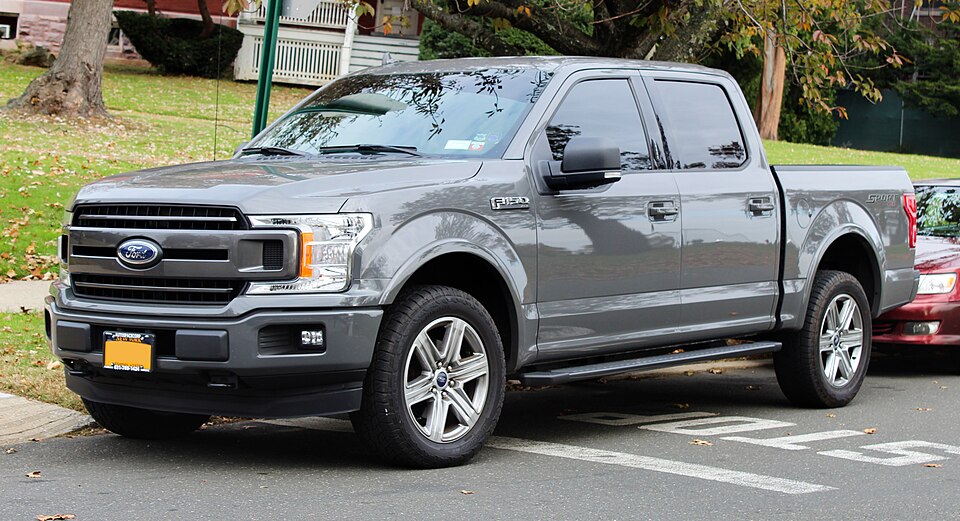
Ford F-150
22 model years from 2005 to 2026, compared on size, efficiency, safety and reliability.
- Model years
- 2005–2026
- Class
- Standard Pickup Trucks 2WD, Standard Pickup Trucks 4WD
- Latest engines
- 3.5L 6-cyl turbo, 2.7L 6-cyl turbo, 5.0L 8-cyl, 5.2L 8-cyl
- Best MPG
- 15–25 combined, by year
- Latest rating
- Not rated
- Recalls
- 124 campaigns, all years
- Most complaints
- 2013 (2,758)
- Fewest problems
- 2023
- Interest
- 37,618 Wikipedia views / 30 days
The 2026 F-150 in brief
The 2026 Ford F-150 is a standard pickup truck offered with 4 engines (3.5L 6-cyl turbo, 2.7L 6-cyl turbo, 5.0L 8-cyl and 5.2L 8-cyl), including a hybrid version and rear-wheel drive and part-time 4-wheel drive.
It measures about 241 inches long and 80 inches wide on a 157-inch wheelbase, with a curb weight of roughly 5,584 lb (Hybrid P/U Supercrew 6.5-Ft Box 4X4).
EPA rates its most efficient version at 24 MPG combined (23 city / 25 highway), 17% better than the 2026 standard pickup truck average of 20.5 MPG, for an estimated $2,800 a year in fuel.
It has 8 recall campaigns on file and owners have filed 18 complaints with NHTSA since 2015, most often about the service brakes.
The Ford F-150 has 22 model years in our data, from 2005 to 2026, classed as Standard Pickup Trucks 2WD, Standard Pickup Trucks 4WD.
Its most efficient year was 2023 at 25 MPG combined; across all years the best version ranged from 15 to 25 MPG.
Owners most often report problems with the power train (7,748), engine (3,483), electrical system (2,258).
Buying used? 2024 has the fewest problems in our data, and 2018 is the year to avoid.
2021 has the most recalls (29); all years together count 124 campaigns and 21,436 owner complaints.
How the 2005 F-150 compares
The 2005 Ford F-150 is a standard pickup truck offered with 3 engines (4.2L 6-cyl, 4.6L 8-cyl and 5.4L 8-cyl) and rear-wheel drive and 4-wheel or all-wheel drive.
It measures about 208 inches long and 79 inches wide on a 126-inch wheelbase, with a curb weight of roughly 4,758 lb (P/U Reg Cab 78 In. Box).
About the Ford F-150
The Ford F-Series is a series of light-duty trucks marketed and manufactured by the Ford Motor Company since model year 1948 as a range of full-size pickup trucks—positioned between Ford's Ranger and Super Duty pickup trucks. Alongside the F-150, the F-Series also includes the Super Duty series, which includes the heavier-duty F-250 through F-450 pickups, F-450/F-550 chassis cabs, and F-600/F-650/F-750 Class 6–8 commercial trucks.
From the Wikipedia article "Ford F-Series", licensed under CC BY-SA 4.0.
2026 F-150 pros & cons
Full 2026 details →What's good
- Excellent fuel economyUp to 24 MPG combined — 17% better than the average 2026 standard pickup truck (20.5 MPG).
- Hybrid version availableOffered as a hybrid as well as gas.
- AWD / 4WD available
- Lots of standard safety tech4 of 5 key driver aids standard on the versions we checked.
Watch out for
No weak spots against similar models in the data.
Best and worst years to buy used
2024 F-150
232 owner complaints · 11 recalls · 4 fire reports · 21 crash reports
Year to avoid2018 F-150
2,325 owner complaints · 18 recalls · 33 fire reports · 64 crash reports
Most reported: Power Train
NHTSA recalls and complaints for 10 model years since 2015; use it alongside a pre-purchase inspection. How we calculate this →
Compare head to head
F-150 changes by model year
- 2024
- New body dimensions: 34.2 in longer, wheelbase +34.3 in — most likely a redesign or new generation
- Engine dropped: 3.3L 6-cyl
- Best combined MPG down from 25 to 23
- 2023
- Engine added: 5.2L 8-cyl
- 2022
- No diesel version any more
- Engine dropped: 3.0L 6-cyl turbo
- 2021
- New hybrid version
- 2018
- New diesel version
- Engines added: 3.0L 6-cyl turbo and 3.3L 6-cyl
- Engine dropped: 3.5L 6-cyl
- Best combined MPG up from 22 to 25
- 2015
- New body dimensions: 10.2 in shorter, wheelbase −11.1 in — most likely a redesign or new generation
- Engines added: 2.7L 6-cyl turbo and 3.5L 6-cyl
- Engines dropped: 3.7L 6-cyl and 6.2L 8-cyl
- Best combined MPG up from 19 to 22
- 2014
- New body dimensions: 7.9 in longer, wheelbase +7.5 in — most likely a redesign or new generation
- 2011
- Engines added: 3.7L 6-cyl, 3.5L 6-cyl turbo, 5.0L 8-cyl and 6.2L 8-cyl
- Engines dropped: 4.6L 8-cyl and 5.4L 8-cyl
- Best combined MPG up from 17 to 19
- 2009
- Engine dropped: 4.2L 6-cyl
Years without a measurable change are left out.
Show all 22 model years side by side
| Year | Latest engines | Best MPG / range | Length | Weight | Overall | Recalls | Complaints |
|---|---|---|---|---|---|---|---|
| 2026 | 3.5L 6-cyl turbo, 2.7L 6-cyl turbo, 5.0L 8-cyl | 24 MPG | 241.3 in | 5,584 lb | Not rated | 8 | 18 |
| 2025 | 3.5L 6-cyl turbo, 2.7L 6-cyl turbo, 5.0L 8-cyl | 23 MPG | 241.3 in | 5,584 lb | Not rated | 16 | 128 |
| 2024 | 3.5L 6-cyl turbo, 2.7L 6-cyl turbo, 5.0L 8-cyl | 23 MPG | 241.3 in | 5,584 lb | Not rated | 11 | 232 |
| 2023 | 3.5L 6-cyl turbo, 2.7L 6-cyl turbo, 3.3L 6-cyl | 25 MPG | 207.1 in | 4,019 lb | Not rated | 13 | 511 |
| 2022 | 3.5L 6-cyl turbo, 2.7L 6-cyl turbo, 3.3L 6-cyl | 25 MPG | 207.1 in | 4,019 lb | Not rated | 23 | 816 |
| 2021 | 3.5L 6-cyl turbo, 3.0L 6-cyl turbo, 2.7L 6-cyl turbo | 25 MPG | 207.1 in | 4,019 lb | Not rated | 29 | 1,302 |
| 2020 | 3.0L 6-cyl turbo, 3.3L 6-cyl, 2.7L 6-cyl turbo | 24 MPG | 207.5 in | 4,050 lb | Not rated | 11 | 741 |
| 2019 | 3.0L 6-cyl turbo, 2.7L 6-cyl turbo, 3.3L 6-cyl | 25 MPG | 207.5 in | 4,050 lb | Not rated | 9 | 1,342 |
| 2018 | 3.0L 6-cyl turbo, 2.7L 6-cyl turbo, 3.3L 6-cyl | 25 MPG | 207.5 in | 4,050 lb | Not rated | 18 | 2,325 |
| 2017 | 2.7L 6-cyl turbo, 3.5L 6-cyl turbo, 3.5L 6-cyl | 22 MPG | 207.5 in | 4,050 lb | Not rated | 17 | 1,462 |
| 2016 | 2.7L 6-cyl turbo, 3.5L 6-cyl turbo, 3.5L 6-cyl | 21 MPG | 207.5 in | 4,050 lb | Not rated | 13 | 2,086 |
| 2015 | 2.7L 6-cyl turbo, 3.5L 6-cyl turbo, 3.5L 6-cyl | 22 MPG | 207.5 in | 4,050 lb | Not rated | 13 | 1,743 |
| 2014 | 3.7L 6-cyl, 3.5L 6-cyl turbo, 5.0L 8-cyl | 19 MPG | 217.7 in | 6,005 lb | Not rated | 8 | 1,516 |
| 2013 | 3.7L 6-cyl, 3.5L 6-cyl turbo, 5.0L 8-cyl | 19 MPG | 209.8 in | 4,760 lb | Not rated | 3 | 2,758 |
| 2012 | 3.7L 6-cyl, 3.5L 6-cyl turbo, 5.0L 8-cyl | 19 MPG | 209.8 in | 4,760 lb | Not rated | 4 | 1,385 |
| 2011 | 3.7L 6-cyl, 3.5L 6-cyl turbo, 5.0L 8-cyl | 19 MPG | 209.8 in | 4,760 lb | Not rated | 6 | 1,711 |
| 2010 | 4.6L 8-cyl, 5.4L 8-cyl | 17 MPG | 209.8 in | 4,760 lb | Not rated | 1 | 490 |
| 2009 | 4.6L 8-cyl, 5.4L 8-cyl | 17 MPG | 209.8 in | 4,760 lb | Not rated | 1 | 151 |
| 2008 | 4.2L 6-cyl, 4.6L 8-cyl, 5.4L 8-cyl | 16 MPG | 207.9 in | 4,758 lb | Not rated | 0 | 177 |
| 2007 | 4.2L 6-cyl, 4.6L 8-cyl, 5.4L 8-cyl | 16 MPG | 207.9 in | 4,758 lb | Not rated | 0 | 158 |
| 2006 | 4.2L 6-cyl, 4.6L 8-cyl, 5.4L 8-cyl | 16 MPG | 207.9 in | 4,758 lb | Not rated | 1 | 158 |
| 2005 | 4.2L 6-cyl, 4.6L 8-cyl, 5.4L 8-cyl | 15 MPG | 207.9 in | 4,758 lb | Not rated | 1 | 226 |
Alternatives to the 2026 F-150
| Model | Best MPG / range | NHTSA overall | Recalls |
|---|---|---|---|
| 2026 Chevrolet Silverado | 25 MPG | Not rated | 7 |
| 2026 Toyota Tundra | 22 MPG | Not rated | 2 |
| 2026 Ram 1500 | 22 MPG | Not rated | 9 |
| 2026 GMC Sierra | 25 MPG | Not rated | 6 |
Most common owner-reported problems
Sources: EPA, NHTSA, Transport Canada, Wikipedia, Wikimedia Commons. Not affiliated with NHTSA, the EPA or Ford. How we calculate this →