 DecodedCars
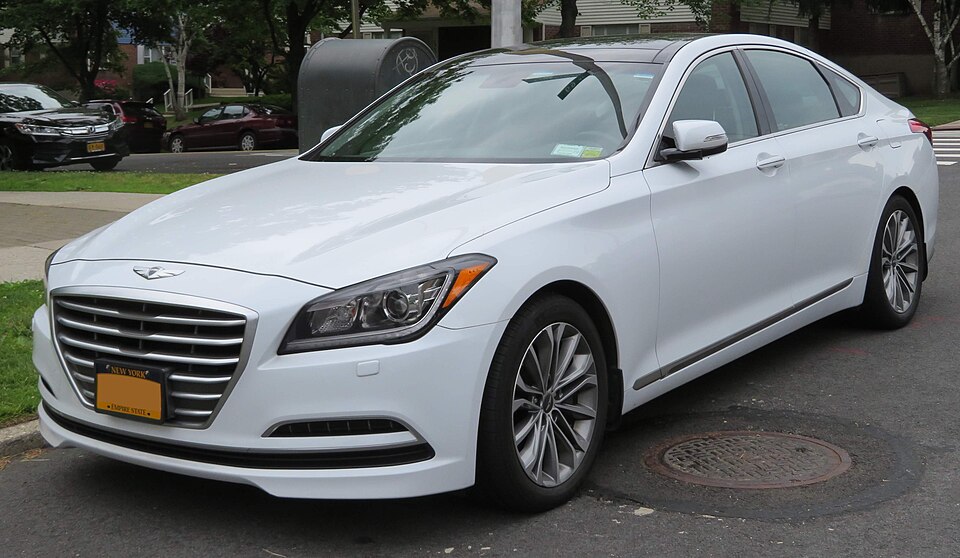
Hyundai Genesis 2015
Versiones, desempeño, equipamiento, consumo, seguridad y problemas conocidos, con sus ventajas y desventajas frente a modelos similares 2015.
- Clase
- Auto grande
- Carrocerías
- 2dr Coupe RWD 3.8 GT, 4dr Sedan AWD 5.0 Ultimate, 4dr Sedan AWD 3.8 Premium/3.8 Lux/3.8 Tec
- Motores
- 3.8L 6 cil., 5.0L 8 cil.
- Tracción
- Tracción trasera, Tracción total (AWD)
- Combustible
- Gasolina regular, Gasolina premium
- MPG (mejor)
- 22 combinadas · 18 ciudad / 28 carretera
- Largo
- 182.3–196.5 in
- Peso en vacío
- 3,589–4,687 lb
- Calificación NHTSA
- ★★★★★
- Retiros
- 10 campañas
Ventajas y desventajas
Lo bueno
- Tracción total / 4x4 disponible
- 5 estrellas en seguridad NHTSALa máxima calificación general en las pruebas de choque federales.
A tener en cuenta
- Retiro con aviso de "estacionar afuera"Verifica que la reparación del retiro esté hecha antes de comprarlo o manejarlo.
Calculado con datos de la EPA, la NHTSA y vPIC frente a 11 modelos similares 2015; no es una reseña. Cómo lo calculamos →
Resumen
El Hyundai Genesis 2015 es un auto grande disponible con 2 motores (3.8L 6 cil. y 5.0L 8 cil.), con tracción trasera y tracción total (AWD).
Mide unas 182 pulgadas de largo y 73 de ancho, con una distancia entre ejes de 111 pulgadas, y pesa alrededor de 3,589 lb (2dr Coupe RWD 3.8 GT).
La EPA califica su versión más eficiente con 22 MPG combinadas (18 en ciudad / 28 en carretera), un 5 % mejor que el promedio de su clase (auto grande, 2015: 20.9 MPG), con un gasto estimado de $3,050 al año en combustible.
En las pruebas de choque de la NHTSA obtuvo la máxima calificación general de 5 estrellas.
Tiene 10 campañas de retiro registradas y los propietarios han presentado 306 quejas ante la NHTSA desde 2015, sobre todo por problemas de sistema eléctrico.
Novedades del 2015
- Motor retirado: 2.0L 4 cil. turbo
- Ahora disponible con tracción total o 4x4
- Ya probado por la NHTSA: 5 estrellas en general
Comparado con 2014; no incluye cambios de versiones, equipamiento ni precio. Ver el Genesis 2014 →
Dimensiones y peso
| Carrocería | Largo | Ancho | Alto | Distancia entre ejes | Vía del. / tras. | Peso en vacío | Peso del./tras. |
|---|---|---|---|---|---|---|---|
| 2dr Coupe RWD 3.8 GT | 182.3 in | 73.2 in | 54.7 in | 111 in | 64.2 / 63.8 in | 3,589 lb | 55/45 |
| 4dr Sedan AWD 5.0 Ultimate | 196.5 in | 74.8 in | 57.9 in | 118.5 in | 64.6 / 65.7 in | 4,687 lb | 52/48 |
| 4dr Sedan AWD 3.8 Premium/3.8 Lux/3.8 Tec | 196.5 in | 74.8 in | 57.9 in | 118.5 in | 64.6 / 65.7 in | 4,295 lb | 52/48 |
Transport Canada CVS (Open Government Licence – Canada), medidas del mercado canadiense.
¿Cabe en tu garaje? Compruébalo con tus medidas →Motores, consumo y costo de uso
| Versión | Motor | Transmisión | Tracción | Ciudad / Carr. / Comb. | vs. su clase | Combustible / año | CO₂ g/mi |
|---|---|---|---|---|---|---|---|
| Genesis RWD | 3.8L 6 cil. | Automática 8-spd | Tracción trasera | 18 / 28 / 22 | +5% | $3,050 | 411 |
| Genesis AWD | 3.8L 6 cil. | Automática 8-spd | Tracción total (AWD) | 16 / 25 / 19 | -9% | $3,550 | 460 |
| Genesis Coupe | 3.8L 6 cil. | Automática (S8) | Tracción trasera | 16 / 25 / 19 | -20% | $4,350 | 458 |
| Genesis Coupe | 3.8L 6 cil. | Manual 6-spd | Tracción trasera | 16 / 24 / 19 | -20% | $4,350 | 460 |
| Genesis RWD | 5.0L 8 cil. | Automática 8-spd | Tracción trasera | 15 / 23 / 18 | -14% | $4,550 | 502 |
Estimaciones de la EPA; "vs. su clase" compara las MPG combinadas con el promedio 2015 de su clase EPA. Cómo lo calculamos →
Calificaciones de seguridad y tecnología
| Versión | General | Frontal | Conductor / pasajero | Lateral | Poste lateral | Volcadura | Riesgo de volcadura |
|---|---|---|---|---|---|---|---|
| 2015 Hyundai Genesis 4 DR AWD | ★★★★★ | ★★★★★ | 5★ / 5★ | ★★★★★ | ★★★★★ | ★★★★★ | 9.5% |
| 2015 Hyundai Genesis 4 DR RWD | ★★★★★ | ★★★★★ | 5★ / 5★ | ★★★★★ | ★★★★★ | ★★★★★ | 9.5% |
| 2015 Hyundai Genesis 2 DR RWD | Sin calificar | Sin calificar | –★ / –★ | Sin calificar | Sin calificar | ★★★★★ | 8.2% |


Auto grande similares 2015
| Modelo | Mejor MPG / autonomía | General NHTSA | Retiros |
|---|---|---|---|
| Hyundai Genesis 2015 (este auto) | 22 MPG | ★★★★★ | 10 |
| Ford Mustang 2015 | 25 MPG | ★★★★★ | 11 |
| Honda Accord 2015 | 47 MPG | Sin calificar | 6 |
| Toyota Camry 2015 | 40 MPG | ★★★★★ | 1 |
| Chevrolet Camaro 2015 | 22 MPG | ★★★★★ | 1 |
| Nissan GT-R 2015 | 19 MPG | Sin calificar | 1 |
| Volkswagen Passat 2015 | 34 MPG | ★★★★★ | 7 |
Retiros (10)
Texto oficial de la NHTSA (en inglés).
Asientos › Front Assembly › Power Adjust · 8 oct 2026 Estacionar afuera
Campaña NHTSA 26V664000 · 94,622 vehículos
- Problema
- Hyundai Motor America (Genesis) is recalling certain 2015-2016 Hyundai Genesis, and 2017-2020 Genesis G80 vehicles. The front power seat motors may overheat due to a stuck power seat control switch, which can result in a fire while parked or driving.
- Riesgo
- A fire increases the risk of injury.
- Solución
- Owners are advised to park their vehicles outdoors and away from other vehicles or structures until the repair has been performed. The remedy is currently under development. Owner notification letters are expected to be mailed December 7, 2026. Owners of Hyundai vehicles may contact Hyundai customer service at 1-855-371-9460. Genesis owners may contact Genesis customer service at 844-340-9741. Hyundai recall number for this recall is 308 and Genesis' recall number is 035G. Vehicle Identification Numbers (VINs) involved in this recall became searchable on NHTSA.gov beginning October 13, 2026.
Sistema eléctrico › Starter Assembly › Solenoid · 13 feb 2024 Estacionar afuera
Campaña NHTSA 24V107000 · 90,907 vehículos
- Problema
- Hyundai Motor America (Hyundai) is recalling certain 2015-2016 Genesis, 2017-2019 Genesis G80, Genesis G90, and 2019 Genesis G70 vehicles. Water may enter the starter solenoid and cause an electrical short, which can result in an engine compartment fire while parked or driving.
- Riesgo
- An engine compartment fire while parked or driving can increase the risk of injury.
- Solución
- Owners are advised to park outside and away from structures until the recall repair is complete. Dealers will install a remedy relay kit in the engine junction box, free of charge. Owner notification letters were mailed July 15, 2024. Owners may contact Hyundai customer service at 1-855-371-9460. Hyundai's numbers for this recall are 254(H) and 018G(G).
Frenos hidráulicos › Antilock/Traction Control/Electronic Limited Slip › Control Unit/Module · 22 sept 2023 Estacionar afuera
Campaña NHTSA 23V651000 · 1,649,478 vehículos
- Problema
- Hyundai Motor America (Hyundai) is recalling certain 2011-2015 Elantra, Genesis Coupe, Sonata Hybrid, 2012-2015 Accent, Azera, Veloster, 2013-2015 Elantra Coupe, Santa Fe, 2014-2015 Equus, 2010-2012 Veracruz, 2010-2013 Tucson, 2015 Tucson Fuel Cell, and 2013 Santa Fe Sport vehicles. The Anti-Lock Brake System (ABS) module may leak brake fluid internally and cause an electrical short, which can result in an engine compartment fire while parked or driving.
- Riesgo
- An engine compartment fire while parked or driving can increase the risk of injury.
- Solución
- Owners are advised to park outside and away from structures until the recall repair is complete. Dealers will replace the ABS fuse, free of charge. Owner notification letters were mailed April 10, 2024 through October 11, 2024. Owners may contact Hyundai customer service at 1-855-371-9460. Hyundai's number for this recall is 251.
Frenos hidráulicos › Antilock/Traction Control/Electronic Limited Slip › Control Unit/Module · 10 mar 2021 Estacionar afuera
Campaña NHTSA 21V160000 · 94,646 vehículos
- Problema
- Hyundai Motor America (Hyundai) is recalling certain 2015-2016 Genesis and 2017-2020 Genesis G80 vehicles. The Anti-Lock Brake System (ABS) module could malfunction and short circuit.
- Riesgo
- An electrical short circuit inside the ABS module could cause an engine compartment fire while parked or driving.
- Solución
- Owners are advised to park outside and away from structures until the remedy is complete. Hyundai will notify owners, and dealers will replace the ABS module fuse, free of charge. Owner notification letters were mailed July 6, 2021. Owners can contact Hyundai customer service at 1-855-371-9460. Hyundai's numbers for this recall are 201 and 006G.
Freno de estacionamiento › Indicator Light · 5 jun 2017
Campaña NHTSA 17V359000 · 161,074 vehículos
- Problema
- Hyundai Motor America (Hyundai) is recalling certain 2015-2016 Sonata and Genesis vehicles. In the affected vehicles, the warning light to indicate that the parking brake is applied may intermittently not illuminate in the dash due to corrosion in the switch.
- Riesgo
- If the parking brake indicator is not illuminated when the parking brake is applied, the driver may operate the vehicle with the parking brake partially engaged, increasing the risk of a crash.
- Solución
- Hyundai will notify owners, and dealers will replace the parking brake switch, free of charge. The recall began on August 4, 2017. Owners may contact Hyundai customer service at 1-855-671-3059. Hyundai's number for this recall is 164.
Bolsas de aire › Sensor › Occupant Classification · 7 oct 2016
Campaña NHTSA 16V722000 · 84,500 vehículos
- Problema
- Hyundai Motor America (Hyundai) is recalling certain model year 2010-2016 Genesis Coupe vehicles manufactured December 12, 2008, to June 11, 2016. The electrical harness connector for the front passenger seat Occupant Classification System (OCS) may dislodge when the seat is moved.
- Riesgo
- In the event of a crash necessitating deployment of the passenger frontal air bag, the disconnected OCS would, by default, cause the first stage, and only the first stage, of the air bag to deploy, whether there is a child seat in the front seat and the bag should not deploy or if the crash is severe and both stages should deploy. Either scenario increases the risk of injury to the front seat occupant.
- Solución
- Hyundai will notify owners, and dealers will secure the OCS connector to prevent it from disconnecting, free of charge. Parts are not currently available and a second letter will be sent to owners when parts are available. Owners may contact Hyundai customer service at 1-855-371-9460. Hyundai's number for this recall is 151.
Sistema eléctrico › Instrument Cluster/Panel · 2 ago 2016
Campaña NHTSA 16V575000 · 3,031 vehículos
- Problema
- Hyundai Motor America (Hyundai) is recalling certain model year 2015 Genesis sedans manufactured February 1, 2015, through May 20, 2015. The affected vehicles are equipped with a seven-inch TFT-LCD instrument cluster that may display an incorrect vehicle speed or may illuminate all of the warning lights or not illuminate a warning light that needs to be lit.
- Riesgo
- If the instrument cluster displays the vehicle speed or illuminates the warning lights incorrectly there would be an increased risk of a crash.
- Solución
- Hyundai will notify owners, and dealers will update the instrument cluster software, free of charge. The recall is expected to begin on September 30, 2016. Owners may contact Hyundai customer service at 1-800-633-5151. Hyundai's number for this recall is 147.
Neumáticos › Sidewall · 22 dic 2015
Campaña NHTSA 15V864000 · 11,142 vehículos
- Problema
- Hyundai Motor America (Hyundai) is recalling certain model year 2015 Genesis vehicles manufactured March 3, 2014, to February 9, 2015, and equipped with Hankook Ventus S1 noble2 tires installed as original equipment. The affected tires may develop cracks in the tire sidewall, resulting in a loss of air.
- Riesgo
- Tire sidewall cracks could cause a rupture during use, resulting in a rapid air loss and loss of vehicle control, increasing the risk of a crash.
- Solución
- Hyundai will notify owners, and dealers will replace the factory tires with tires of another brand, free of charge. The recall began February 19, 2016. Owners may contact Hyundai customer service at 1-855-671-3059. Hyundai's number for this recall is 138.
Tren motriz › Driveline › Differential Unit · 16 nov 2015
Campaña NHTSA 15V756000 · 10,800 vehículos
- Problema
- Hyundai Motor America (Hyundai) is recalling certain model year 2013-2015 Genesis Coupe vehicles manufactured December 28, 2011, to April 6, 2015, equipped with manual transmissions. In the affected vehicles, if the differential and the suspension rear crossmember were not properly aligned during vehicle assembly, the bolts that secure the differential may loosen.
- Riesgo
- If the rear differential loosens from its mounting position, the driveshaft may disconnect from the differential, resulting in a loss of propulsion and an increased risk of a crash.
- Solución
- Hyundai will notify owners, and dealers will verify the proper assembly of the differential, free of charge. The recall began on December 30, 2015. Owners may contact Hyundai's customer service at 1-855-671-3059. Hyundai's number for this recall is 135.
Iluminación exterior › Tail Lights · 19 feb 2015
Campaña NHTSA 15V097000 · 24,400 vehículos
- Problema
- Hyundai Motor America (Hyundai) is recalling certain model year 2015 Genesis vehicles manufactured February 21, 2014, to January 24, 2015. Water may leak into the rear combination lamp assemblies and cause an incorrect gear display on the instrument panel or a delay in the engagement of the selected gear when the vehicle is shifted from Park to Reverse or Drive.
- Riesgo
- If the incorrect gear is being displayed, the vehicle may move in an unintended direction, increasing the risk of a crash.
- Solución
- Hyundai will notify owners, and dealers will apply pads to prevent water intrusion into the combination lamp housing, free of charge. The recall began on April 14, 2015. Owners may contact Hyundai customer service at 1-855-671-3059. Hyundai's number for this recall is 128.
No todos los Genesis 2015 están afectados: solo el VIN lo confirma.
Problemas reportados por propietarios
Reportes sin verificar; los más vendidos acumulan más.
Lista para comprar un Hyundai Genesis 2015 usado
- Consulta el VIN en nhtsa.gov/recalls. 10 retiros en este año: pide comprobantes de reparación.
- Retiro crítico de seguridad. Al menos un retiro tiene aviso de "no conducir" o "estacionar afuera". No lo compres hasta que el VIN muestre que se reparó.
- Sistema eléctrico — 111 reportes de propietarios. Prueba todas las ventanas, seguros, luces, pantallas y puertos USB; revisa la antigüedad de la batería.
- Motor — 45 reportes de propietarios. Arranca el motor en frío, escucha si golpetea y fíjate en luces de advertencia o titubeos al acelerar.
- Iluminación exterior — 41 reportes de propietarios. Revisa todas las luces exteriores, los limpiaparabrisas y que el parabrisas no tenga grietas.
- Millaje a vigilar. Los propietarios suelen reportar problemas alrededor de las 30,000 millas; pregunta qué se reparó cerca de ese punto.
- Antes de pagar: historial de servicio, reporte de antecedentes e inspección de un mecánico independiente.
Generado por DecodedCars a partir de retiros y quejas de propietarios ante la NHTSA para el Hyundai Genesis 2015. No sustituye una inspección profesional.
Otros años del Genesis
Comparar todos los años →| Año | MPG (mejor) | Largo | General | Retiros | Quejas |
|---|---|---|---|---|---|
| Genesis 2016 | 22 | 182.3 in | ★★★★★ | 6 | 104 |
| Genesis 2014 | 22 | 182.3 in | Sin calificar | 3 | 44 |
| Genesis 2013 | 24 | 182.3 in | Sin calificar | 4 | 162 |
| Genesis 2012 | 24 | 182.3 in | Sin calificar | 5 | 229 |
| Genesis 2011 | 24 | 182.3 in | Sin calificar | 6 | 116 |
| Genesis 2010 | 24 | 182.3 in | Sin calificar | 5 | 85 |
| Genesis 2009 | 21 | 182.3 in | Sin calificar | 3 | 98 |
Fuentes: EPA, NHTSA, Transport Canada, Wikimedia Commons. Sin afiliación con la NHTSA, la EPA ni Hyundai. Cómo lo calculamos →